7. The pantherskin & Lycourgos
M.Detienne[1]
has a chapter on “The perfumed panther” about the strange beliefs surrounding
the panther. From the mountains in Armenia it sneaks down to hunt and by the
strong scent it sends out (the lovely smell of the paradise mountain) it
attracts its poor victims. But the maenad is also the perfumed panther.
Sophocles talks about the maenad in
“pantherskin”[2] and Dilthey
has shown[3]
that this cloak of skin was the typical hunting-clothes for “the wild hunter”
Zagreus and his hunting bitches. Oppian
quotes from older Orfic authors that the maenads were changed to panthers
before they tore the bull to pieces[4].
The name of the great hunter in the Bible is Nimrod, the Assyrian name for the
“panther” nimru.
Lycourgos is
already mentioned in the Iliad as he, who attacks Dionysos with a bouplex, often trans. “the stick to
drive the ox”, but it could also be the axe to kill the ox. Ovid Met. IV, 22 calls Lycourgos bipenniferus (“carrier of a double
axe”), and Nonnos has acc to G.Zoega
taken the bouplex to be a double axe[5]
and calls it a weapon given by Hera to use against gods. Zoega brings this
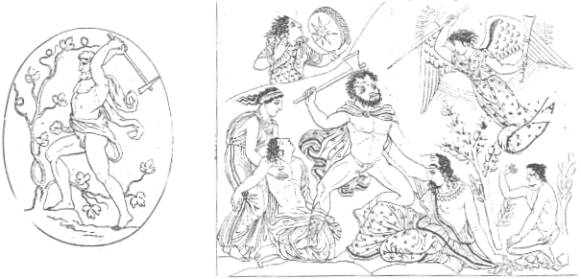
copper print of a sarcophagus now lost[6]:

In an article about gems Zoega
describes the following piece[7]:
“A bearded and strong man, naked
except for a panther's skin bound to his waist and waving behind him, so stands
Lycourgos with a bipennis raised in both hands and turned against a vine tree”.
The fact that the victim of the
violent bull-killer can also be seen as a tree, shows that the bull is the god
of vegetation[8]. The last
picture shows how Lycourgos is punished by the gods with blinding. Even though
the Dionysos myth often fuses the “hunter” with his victim, Dionysos being the
leader of the wild hunt, but also becoming its victim and getting torn to
pieces, there is a faint memory that these two were originally opponents: “The
ox-born” and “the ox-killer”. Like Orion, Lycourgos is punished with blindness.
The most prominent source to the
Arabian Lycourgos are the friezes (now almost worn away) by the entrance to
adyton in the Bacchus temple in Baalbeck[9]
and Nonnos Dion. XX, 146ff. Nonnos tells us how Lycourgos, king over the
city situated on Mt.Nysa, has his gates adorned with heads and feet cut off
from human bodies. He chases the Dionysos child into the sea and attacks
Ambrosia, who by the intervention of mother Earth is changed into a wine tree,
which immediately flings its runners around the king and keeps him bound to the
spot. He is doomed by the gods to wander from place to place as a blind man,
but at last he gets a place among the eternal gods, for the Arabs give
libations to him on “smoking altars”. The friezes from the Bacchus temple show
scenes with Lycourgos and the metamorphosis of Ambrosia.
All the traces of Indo-European
wolf-warrior ideology (Lycourgos means “he who acts like a wolf”) have
disappeared in this version, and the myth is concentrated on the confrontation
between the goddess of vegetation and the man with the axe. Ambrosia is not an
ordinary nymph. She is the tree of life-giving ambrosia, and Nysa is the paradise
mountain in the land of the incense-trees.
Important is Lycourgos´ continued
threat: that he will burn the wine leaf with “Arabian fire” (XX 237, XXI
135ff.). He is the summer heat, who threatens to dry out the vegetation. A
mosaic from Djemila-Cuicul in Algeria shows Ambrosia being attacked by
Lycourgos[10], cf. the
coins from Afrodisias, where the sacred tree is also a female.
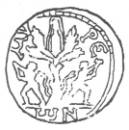

The coin is from A.B.Cook: Zeus II, fig. 620 & 621-3.