9. The Gilgamesh-epos
In this epos Gilgamesh is king & builder of the wall of Uruk. Enkidu a man of nature.
At the beginning of the
epic G. is depicted as having “no rival” to balance his rough and violent
behavior.
We are here able to detect
remnants of the old myth of the primeval twins: a) The man of nature = the
shepherd and b) the first founder of a city = the bringer of civilization,
often identified with the great hunter, the violent one. As the Assyrian
palaces are guarded both by the great winged a) bull-men and the b) lion-men
representing both the a) life-giving forces and the b) demonic, violent forces,
so life is in some kind of balance when the extreme violent nature of Gilgamesh
is tied in strong friendship to the unspoiled Enkidu. Enkidu is one with the
cattle, “with the cattle he eats vegetation” “dressed as cattle are” with long
tresses “like a woman".
The motif so common on
Mesopotamian seals of a bull-man fighting a naked man with 6 great curly locks
of hair cannot be proved to be Gilgamesh and Enkidu. Perhaps they are much
older. But Gilgamesh and Enkidu can be proved to be a variant of the older
motif the shepherd/bull-man and the great hunter.
Enkidu is closely
connected to the herd: “He kept pulling out the traps laid by the hunter”. “He
kept helping the cattle”. Enkidu is the good shepherd guarding the animals
against the hunter killing the animals. He is androgynous and thereby one with
the great nature. But when he meets the harlot “for six days and seven nights Enkidu
poured himself into Shamhat” The result is a loosening of ecstatic strength:
“Enkidu had been diminished, he could not run as before”. In the episode with
the harlot Enkidu loses androgynous strength and drops to the level of normal
male consciousness: “Knowing his own mind (now), he would seek for a friend”. Enkidu is not the noble savage, he is the primeval
ecstatic.
Religion in these early days was not so much dogma as it
was feeling, ecstasy and mystical experience. Gilgamesh is Lord of the
underworld. In the Sumerian version we find a text celebrating the death of the
“Great Wild Oxe”. Each year in the month of izi-izi-gar
(“Lighting the Bonfire”) the Babylonian month of abu (July-August) there
shall be a feast for the dead spirits. The young men and the warriors shall
come out in the open and before the city gate they shall do
wrestling-competitions and fist-fighting. In their translation of the epos into
Danish, the translators U. & Aa.Westenholz also mention an astronomical
text (8th cent. BC) where it is written about the month abu: “Its star is the
Arrow (= Sirius), fire pans are lit, a torch lifted for Anunnaki. Fire comes
down from heaven and competes with the sun. It is also the month of Gilgamesh.
On the 9th day they shall bring the young men out from the town to wrestle”[1].
As Gilgamesh prepares to travel to the Cedermountain to
cut down ceders, Utu, the sun god gives him seven demons to accompany him. Baal
is followed by his “7 servants, 8 pigs”, where pig certainly is not the pink
fellow we know, but a demonic animal with tusks and black mud-stained fur,
shortsighted and with bad temper, and used as an offering to chthonic gods.
Dumuzi is killed by seven demons rising from the underworld. The great God from
Sidon, Eshmun, is in his myth pictured as a hunter and carries a name meaning
“the 8th”. He is followed by the 7 kabirs, himself being the 8th.
Gilgamesh going to cut down the cedars is followed by a
mixed company of 7 demons and 50 young men. The attack of men and demons on the
god of vegetation is a motif inherited from Catal Hüyük. This wild hunt has
some death-transcending meaning, and even in Hellenistic time motifs of hunting
are everywhere on the sarcophagi. This conquering-death-motif is also felt in
the Sumerian version of the epos. It starts with Gilgamesh seeing people dying
all over Uruk and corpses floating down the river outside. But the hope is not
for eternal life, but to be lord of the underworld among the spirits and
judging the dead (just like Osiris), as a prayer to Gilgamesh from 8th-7th
cent. B.C. proves[2]. Not eternal
life, but “to be a light to man in the darkness has become your lot, fighting
without defeat, victorious attack”. Therefore the wrestling competitions are a
tribute to Gilgamesh “the strong one, in battle like a devastating storm-flood,
you are the one, who smashes sculls in multitudes”.
The background of the Gilgamesh-figure is the faint
memory of an ecstatic warrior-ideology where the ideals are: letting go of
oneself, feeling the “kick of adrenaline", enjoying the ecstasy of
violence, letting the fire burn.
In the Gilgamesh epos “the bull of heaven” cannot be given to Ishtar, because
this would result in great hunger in Uruk. But Ishtar tells her father Anu that
she has arranged a great storing up of food, so finally she gets the bull. But
it is killed by Gilgamesh about whom it is said (many times) “clad only in a
lion‘s-skin”. About Enkidu it is told “Your mother a gazelle... and cattle made
you familiar with all the pastures”. As Gilgamesh is the great hunter is Enkidu
the young calf erecting the sun’s gate:
“I made a door six poles high and two poles wide”,
says he at the end of tablet V (SBV): “Let the Euphrates carry it to Nippur”[3].
The divine bull, the great hunter and the bull-man
as the guardian of the gate are types well known from the iconography of the
Near East.
A very important motif in early religion is primeval
unity dissolved into duality and reestablished. With his 7 glories Huwawa is
the 7-fold light, unified vision before creation of a structured universe. His
head is the terrifying Babylonian version of the head of Medusa and like this
it has to be kept in a bag. The high gate erected in Nippur is fatal to poor
Enkidu. He is wild nature, before the traveling of the two to the Cedar-mountain
creates an ordered path for the sun to follow and a gate securing its free
entrance into the universe. He knows the paths of Huwawa and Huwawa knows him
from his childhood. He is the mystical creation “of silence”. He is wild nature
stiffened to an ordered universe by the erection of the gate of the sun and
finally he dies.
The
creation of order means death to both Huwawa and Enkidu, both symbols of
primeval unity with wild nature.
Creation
as duality (twins or two warriors) killing the naked god of primeval unity -
marked by 7-fold light + sun & moon or the tree of life, is a motif often
shown on the seals. G.Widengren has shown that the king is often pictured on
seals with a tree of life with 7 globular lights on its 7 branches in his hand.[4]
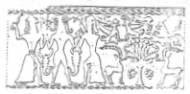
Frankfort, fig 52
The way of Gilgamesh is the way of the sun, he is under
special protection of Shamash, he is the solar hero: “By the road of the sun”
X, 135 Gilgamesh is travelling through thick darkness, until he feels the
North-wind, shortly after he comes out of the tunnel to the garden “of the
gods” X, 172.
The man on the picture below is the sun-hero
travelling/running with the light in the course of the sun, thereby making
space for the light to shine and the rain to fall in a primordial universe
dominated by chaotic primordial waters. Cf. that Gilgamesh on his long journey
to the Cedarmountain is digging wells, IV, 6+39+120.
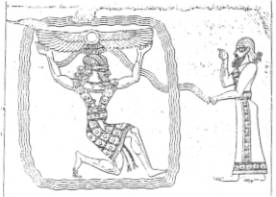
Lajard, Introduction á l´etude de culte public et des mystères en Orient et
en Occident, 1847, pl.XXX, no.7
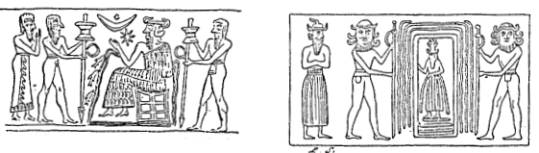
Another seal shows the sun-god coming out between two
mountains or sitting enthroned between two pillars of incense. These two
pillars are the gate of the sun. The two helpers of the sun hero Mithras are
Cautes and Cautopates. They are personifications of the two world pillars seen
as pillars of incense. Mithras is the triple (triplasios) Mithras. On the third picture the divine bull is a mean
to ascend to the heavenly gate (marked with wings). The high god ruling over
this mysterious ascension is seen sitting with the drink of immortality in one
hand. That it is the heavenly drink of life is seen from the fact that it is
one with the drink being contained in the bowl of the crescent moon.
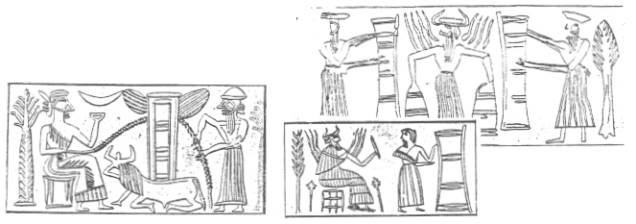
Ward, The seal cylinders of Western Asia,
Publications of the Carnegie Institution, no.100 p.97, no.273 & p.90,
no.255. Lajard, Introduction pl.XVIII,
no.2.
Most rewarding is S.Parpola´s
interpretation of the Gilgamesh Epos[5].
We are not able to follow him in detail, but the main idea worked out by
Parpola that the Epic wants to communicate some kind of secret lore discovered
by Gilgamesh developing from a man with strong passions almost like a beast of
prey to the perfect sage being at rest with himself and being able to attain
supernatural information through his dead friend's spirit, is certainly worth
consideration. The Epic can be viewed as a mystical path of spiritual growth
culminating in the acquisition of esoteric knowledge. To Parpola´s opinion the
epithet “perfect” accorded to Gilgamesh in Tablet I qualifies him as a Kabbalistic
“Zadiq” (“a just man”). The special technique of the Kabbalistic ecstatic “the
posture of Elijah” – putting one´s head between the knees – is used by G. for
attaining dreams, IV 3,6.
The Mesopotamian Gilgamesh can be
pictured as a one-eyed cyclops.[6]
One of the earliest examples is a seal from about 3000 B.C. The one-eyed is
seen dangling with two lions and over his head a goat is chased by a lion.
Porada suggests that “perhaps the rather frequent third hollow on the forehead
of the hero with upright curls in cylinders of the Fara style (3000-2500 B.C.)
… was meant to indicate a third eye”[7].
Porada is cautious in her interpretation, but we think we can say for sure that
the cyclopian eye = the third eye marks him out as an ecstatic.
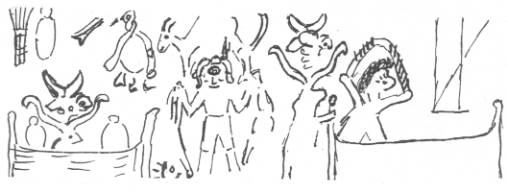
The scene also shows a grotesque man
bending a branch (the Lycourgos motif, see below the chapter on a North Syrian
temple & the Nimrud-ivory) and birds of ecstasy sitting between the mighty
horns of a goat housing in a pen between two big jars. The other pen is laid
waste by “Lycourgos”, and the poor goat thrown out.
To understand the two figures of
Mesopotamian iconography mostly called Gilgamesh and Enkidu we have to go back
to the beginning. Early Sumerian iconography was to a certain degree taken over
from Proto-Elamite, and here we find a couple who must have been the
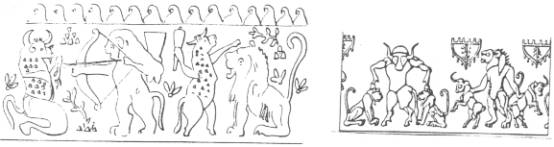
forerunners of “Gilgamesh and Enkidu”. The pictures below are seal impressions
from about 2900 B.C.[8].The
first shows the fight between bull and lion. The lion shooting at the bull and
the bull striking the lion on the head with a club. The second shows the bull
and the lion standing upright on hind legs in a human posture, each forcing two
members of the opposite species into some kind of submission. It is clear from
the Susa-parallels that the bull man´s partner is a lion man and that this is
the reason for his curly hair.
Leon Heuzey[9]
has drawn attention to a cult device often seen in the hands of Gilgamesh: a staff
with a spike at the end to plant it in the ground and at the other end a button
or small disc. See the illustrations from the art. by Heuzey:
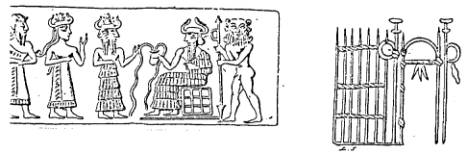

What is the meaning of this
instrument? Gilgamesh is often standing behind the throne of Ea with this staff.
And it can even be doubled into two, something so important for the motif that
also Gilgamesh has to be doubled. The result is a gate through which Ea can
show himself in much the same way as Shamash (= the Sun) appears through the
gate of the sun. The two staffs can also form a portico to a cult hut; they
are, as seen by Heuzey, the two “Heracles columns” building the gate through
which the sun leaves at sunset, and behind which the great Ocean has its
domain. In Mesopotamian religion there was no knowledge of the Straits of
Gibraltar. Here the two columns are seen as the columns which keep the upper
and nether waters apart and create open space in a universe where the periphery
is water. Gilgamesh is the Mesopotamian Heracles, putting up the columns that
separate heaven and earth and create open space for the sun to run its course.
The gate motif from prehistoric Susa
and Egypt:

On the slab below we can see the two
bull men as guardians of the gate.[10]
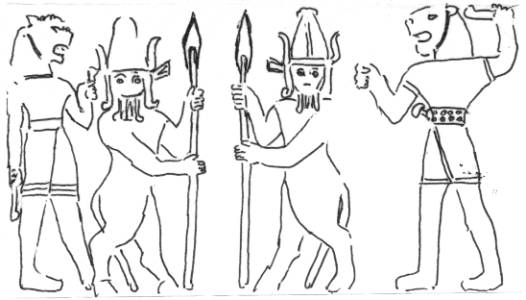
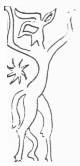

Orthostat
relief Kargamis, about 1050-850 B.C. Archäol. Mus. Ankara.
Just as the sign  is the sign for the divided world pillar, the
split world-mountain and duality, so is the sign to the right the sign of the
undivided world-pillar, which through 3 stages leads to heaven. This sign is
therefore regarded as a very holy symbol and often seen on the top of the
earliest bull temples. But the latent duality is also marked by some kind of
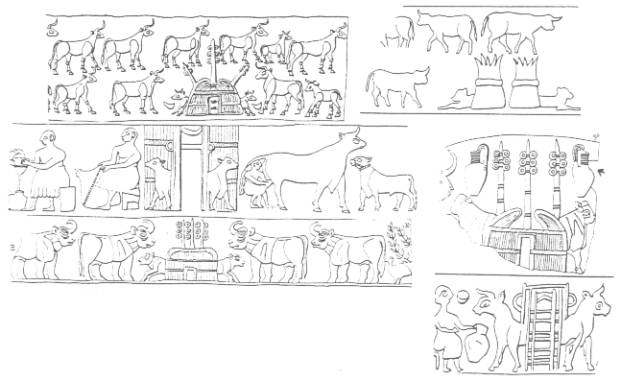
trinity-symbol: the two Heracles pillars with the “ladder to heaven” in the
centre. The two Heracles pillars are often guarded by the son(s) of the bull
god. The pictures below show lots of bulls but only calves as guardians of the
two columns. All the motifs are from the Jemdet Nasr period (after Halaf,
before the Old Sumerian). The pictures are from P.P.Delougaz, “Animals emerging
from a Hut”[11]. He thinks
that the huts/temples are symbols of cows giving birth to calves. But the
explanation of the calves emerging from the side of the huts is the
above-mentioned: the calf as the guardian of the sun gate, the temple gate.
is the sign for the divided world pillar, the
split world-mountain and duality, so is the sign to the right the sign of the
undivided world-pillar, which through 3 stages leads to heaven. This sign is
therefore regarded as a very holy symbol and often seen on the top of the
earliest bull temples. But the latent duality is also marked by some kind of
trinity-symbol: the two Heracles pillars with the “ladder to heaven” in the
centre. The two Heracles pillars are often guarded by the son(s) of the bull
god. The pictures below show lots of bulls but only calves as guardians of the
two columns. All the motifs are from the Jemdet Nasr period (after Halaf,
before the Old Sumerian). The pictures are from P.P.Delougaz, “Animals emerging
from a Hut”[11]. He thinks
that the huts/temples are symbols of cows giving birth to calves. But the
explanation of the calves emerging from the side of the huts is the
above-mentioned: the calf as the guardian of the sun gate, the temple gate.
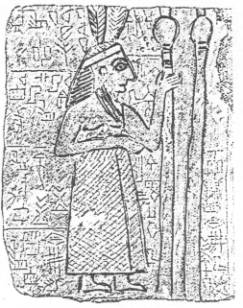
From prehistoric Mesopotamia (Tello,
RA V, fig.36) comes this tablet with
archaic inscription and the hunter with long hair, two feathers and the heavy kilt
with chess-board pattern, the substitute for the leopard's hide. Rawhide kilts
are still worn by the priest officiating in a cultic scene on the famous Hagia
Triada sarcophagi.