13. A common prehistoric religion
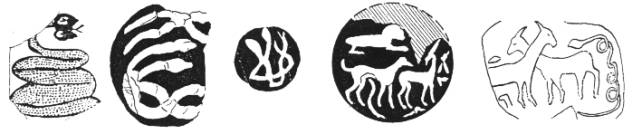
A potsherd from Halaf[1]
shows the coiled snake, and the double snake is seen on two stamps from Tepe
Gawra[2].
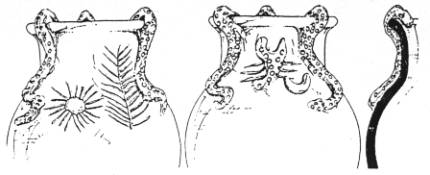
From Tell Brak is shown this remarkable jar with applications. Sun, moon and scorpion,
and snakes drinking from the brim. The snake and the scorpion show that it is
an orgiastic drink to strengthen the snake power[3].
A dog is also seen losing its kundalini power during the pursuit of a horned
animal[4].
But two goats joined together symmetrically are a symbol of raised kundalini[5].
We have used the Mandaean texts as
typical witnesses of Near Eastern folk religion: This also goes for the god of
heaven, the highgod: Ju-shamin is called “strength of the waters”.[6]
The normal Syrian name for the high god is Baalshamin, but the Mandaeans seems
to have preserved some very old traditions about the god giving power/fertility
to the life-giving waters.
In the Mandaean scriptures the two
“ancient and powerful primeval (creatures)” are Baba and Tata. Together with
names like Jajia, Dadai, Qaqai they are the “pet names” of the first elements
like air, fire, milk, and fish. Baba is the divine primeval Ram and means
“Daddy”[7].
In our opinion Hadad[8]
(from Ada, Attis, Hittite: Attash, Sumerian: Adda, Cilician:
* atis = “father”) is a name of this kind. B.Kienast[9]
mentions a lot of “Lallnamen” (pet names) from the Sumerian Pantheon: Alala,
Zababa, Sjidada, Bulala, Belile, Igigi, Aruru, Izuzu. The name Jesus uses for
God “Abba” is a name of the same type as these words (Papa, Daddy, Mama) and
reflects Near Eastern folk religion. Cf. the name Papas for Attis.
In Eleusis we meet the divine couple
Jacche and Baubo, they are acting quite tantrically and norm breaking, J., the
young boy touching the most private parts of the older woman Baubo. In the
creation story we hear about Jahveh and bohu (originally buhw).
In his creation story Philo has
Kol-pi-ja (“voice of the mouth of Ja?”) and Baau. In Mesopotamia we meet Ea/Ia
and Bau.
The reiteration Ja/Jeje Paian and
Bau/Baubo is very common for the third person in the primeval drama, the hunter
Ara (Ararat,Urartu) Kusj (Kaukasus). Other examples are Tartaros, Ninoe,
Dardanos, Dodona, Kykeon, Leleges, Gyges.
“…reiteration is not rare in aboriginal languages of Anatolia”
says E.Herzfeld[10] and he
mentions Briges/Bebrykes. K.Jaritz says
about the language of the Kassite: “In many cases there is reduplication of a
part of the stem and we do not know the reason or meaning of it”[11].
Jaritz seeks to localise the original home of the Kassite people and finds
Kashshiya in East Anatolia or Tepe Gawra. To his opinion it is an aboriginal
population, about 3000 B.C. expelled by Sumerians and Semites (p.81f). Just
like the name Kush becoming the name of a people, so also the name Ara
(Urartu). The myth about Or tells that he was a giant from India killed and now
buried where the river Orontes flows. In the country west of the Jordan River
we meet the giant Og whose name has some connection to Greek Okeanos and Ogyges
and is doubled to Gog, the king coming from the northern periphery and the Ice
Sea. Some cultic devices have a reduplication. The very characteristic libation
pitcher with a long nose is in Akkadian called kukkub(b)u[12]
Hebrew: qab, Greek: kábos is a cubic unit.

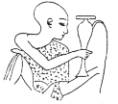

RA
V, pl.2, fig.23; fig. 48-9.
The Egyptian word for the holy
flower, the lotus, is sssn in Hebrew:
susan = “lily”, Greek: suson. Crocus Sanscrit: kunkuman, Akkadian: kurkanu, Hebrew: karkom.
The oldest word for wine is also of
Anatolian origin[13]. The
Sumerian ideogram GESTIN has the phonetic value ui, Greek:oinos, Hebrew: jajin.
T.B.Nayar has proved that ceramics
of the type “black-and-red ware” found in the oldest layers of Harappa has some
similarity to predynastic Egyptian and West Asian “black-and-red ware”[14].
Fairservis has made a list of 35 signs common to Harappan inscriptions and
record keeping and Protoelamittic[15].
Bedr.Hrozny, the famous scholar who
solved the riddle of the Hittite language, has also tried his skills on the
many seals belonging to the Harappa and Mohenjo Daro culture.(A complete
collection of these inscriptions has now been published by a team led by the
Finnish scholar Asko Parpola). Hrozny thinks that the language of the seals is
an Indo-European language, and he finds a similarity with the letters used in
the Hieroglyph-Hittite writings from Eastern Anatolia[16].
Acc to Hrozny the short inscription contains 25-30 different names of gods. The
far most common name is Jaje (in more than 300 inscriptions and also found in
the form Jaj, Ja, Je, I), a name that in Hrozny's opinion is closely connected
to Semitic god Jau/Jave. Jaje is closely connected with the urus-bull, in
scientific litt. often called the “unicorn” because it is always shown with
only one horn (in profile). But this god is also represented by the holy tree
and the man in the tree. The tree is often seen making some kind of semicircle
around Jaje who is inside the tree. He is the spirit of vegetation obviously in
some kind of opposition to the tiger (Hrozny, Ancient History of Western Asia, India and Crete brings a good
summary of his viewpoints). It seems clear that Hrozny´s interpretations would
suit our description of the prehistoric cult of Ja very well, but the
scientific world has not been able to accept Hrozny´s work. Also the name of a
god called Kush and even Shantash is found by Hrozny. But there are different
things that make his interpretation hard to accept. The syllable shi-, the last
part of the name Kushi can be written with 25 different signs, acc. to Hrozny
to make the difference of the seals stand out. But could not this be done
better by variations in the pictures? C.Renfrew, Archaeology and Language (1987), also pleads for an Indo-European
language in the early Indus valley culture. Asko Parpola thinks the
inscriptions have to be interpreted as a Dravidian language, but he agrees that
the Sanskrit-speaking Indo-Europeans of the Vedas are not the first wave of
Indo-European settlers.
My opinion is that we have to admit
the fact that there was a multitude of very different languages being spoken in
the rather small centre of early farming (Mesopotamia and Eastern Anatolia) and
many of them are now extinct. The Sumerian, Elamittic, Kassite, Hurritic and
Hattian languages are only some of them - there must have existed a true
Babylonian-linguistic confusion, Gen 11. So perhaps neither early Indo-European
nor Dravidian languages can offer the clue to this vanished civilisation.
Perhaps Hrozny´s bold theory on
early migrations from a Near Eastern centre has more to say for it. To me it
seems very likely that at least several groups have gone out in search for the
land or holy mountain of Kush, their great god. Mt.Cassios outside Ugarit, in
the U.texts called Khazi, is also called Arr[17],
cf. Caucasus & Ararat. The title “king over Kish” is a title of honour used
by Mesopotamian rulers, and even by those who did not rule the city of Kish,
but had to see it ruled by someone else. H.J.Nissen[18]
thinks that the explanation is to be found in geography: From Kish (13km east
of Babylon) in Upper Mesopotamia, the Euphratriver could be controlled. But to
my opinion Kish could also be the capital of a prehistoric Mesopotamian
kingdom. Kush is the man from the land where the heat and the nearness to the
sun has burned the people black. So his hair is often seen as that of a Negro.
In Greek myth the black warrior is Memnon (with reiteration of the stem Min).
He comes from the land of the rising sun and his mother´s name is Kissia. A
founder of Argos is called Keisos. Kisses, Kisseus, Kissios are names of kings
in Thracia, Kissiné a mountain in Thracia[19].
The great hunter´s numen was represented by the lion, in Greek called lix, in Hebrew lais, in Egypt l/<i.
B.Hrozny has shown[20]
that the words for some items connected with the brewing of beer are the same
in Egypt and Sumer/Mesopotamia: Malt-bread broken to pieces. The species of
grain emmer. Mixing-jars for beer.
De Genouillac (OLZ 11,469) has found that Assyrian marru (pickaxe), Sumerian (gisMAR)
is very similar to the earliest pictures of an Egyptian pickaxe, mr. Many words for farming activity are
pre-Sumerian, even the name for “farmer” (engar),
plough (apin), but also smith (simug), weaver (usbar)[21].
Kienast thinks these words are witness to a “Proto-Eufratian” population
farming the land even before the arrival of the Sumerians.
C.Autran[22]
will explain the early Badari culture of Upper Egypt 5500 B.C. as coming in
from the east through Wadi Hammamat. It brought the bull-god Min, a forerunner
for Ammon. Min is called “the great bull” and “he who opens the rain clouds”
(not typical of the Egyptian situation, where water comes from the flooding of
the Nile) “creator of the tree of life”, and Autran brings this picture of the
bull being pursued by the panther:

From all this it seems clear that
not only the special technique of farming, but also the vocabulary and even the
gods were disseminated together.
This goes especially for the
dominant figure of the great hunter. The figure of a strong man with his bare
hands grabbing or taming two lions is a motif seen in prehistoric Egypt, Susa,
Mohenjo Daro (two tigers) and in Greek mythology (Heracles wrestling with a
lion). He is also seen standing between two rising snakes (Resheph), sometimes
grabbing them, sometimes as in Egypt having the raised snake as a third eye on
his forehead. He is the great magician taming the demonic forces of the dark
side having them at his disposal. The bull is a symbol of divine life-giving,
life-protecting forces whereas the lion is the symbol of the more aggressive
side in man and in cosmos, the killing instinct.
In an important contribution to the
prehistory of the mysteries of Mithras, A.D.H. Bivar[23]
has already dealt with the motifs “the lion killing the bull” and the “Master
of the Beasts”.
Without drawing the line back to the
prehistoric iconography and Catal Hüyük and the idea of the fire killing the
life fluids in vegetation, Bivar has
seen that these symbols cover over a cruel cult even involving the butchering
of humans. He lists the following typical variants of the “Master of Beasts” as
he calls the figure we have chosen to call the “great hunter”:
The Lion-Stabber
The Lion-Strangler
The Lion-Dangler: holds the subdued
animal in a hind leg or the tail
The Lion-Grabbler: grabs one or two
lions by the throat
The Griffon-Grabbler
Bivar treats a Persian (?) Monument
found in Athens (Now in Athens National Mus.) It seems to be from the 4th cent.
B.C.[24]
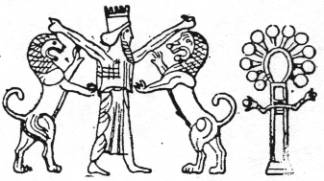
The figure grabbing the two horned
lions wearing a high cylinder hat is well known from official seals from the
Achmenidian royal administration. The same hat is worn by Baal on coins from
Sidon. It seems reasonable to identify him as the Mesopotamian Bel-Marduk. The
horned lion-demon is well known from Assyrian art. It is a genius, a helping spirit for the great magician Bel.
From his diggings in Nimrud Austin
Layard has brought to light this sculpture of a lion-demon standing just behind
a man and in exactly the same position. But the man is not armed. The demon is.
It is the real killer. (The picture is only one example among many of this
important motif.)

We
find the motif a strong man often dressed in a kilt grabbing 2 lions in their
throats disseminated over many prehistoric cultures: Crete, Egypt, prehistoric
Susa and the Mohenjo Daroh-culture in North India (where he is “a
tiger-grabber”).
 Cyprus
  Susa
Susa 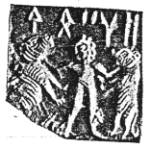 Mohenjo Daroh
Zeus was on
Crete called “the dead Zan”[25].
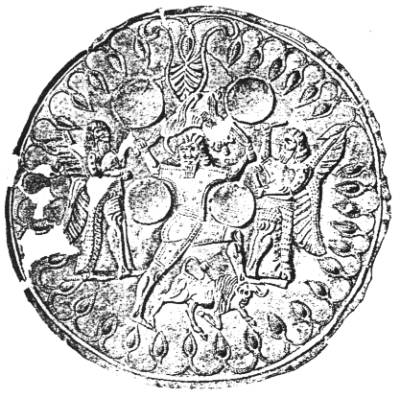
In the cave on Mt Ida, where Pythagoras was initiated, was found this drum of
bronze. Two genii of the Assyrian type is drumming and Zan, not naked, but
dressed in tricot is dancing trampling on a bull, swinging a lion over his head[26]
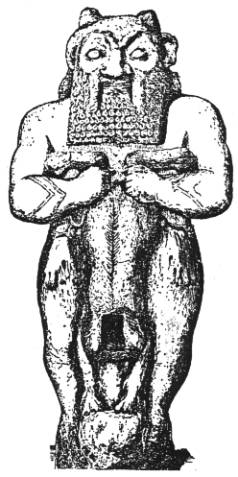
In
Cyprus it is the god Bes mastering the lion (Rawlinson, p. 33). Cf. Lex Icon, Bes (Cypri et in Phoenicia)
19. The monstrous features of the
horned god are not accidental. His kilt is made of the skin of a lion, its paws
hanging from the waist.
Kush is also a very old name of a god giving his name to mountains like
Caucasus, Hazzi = Mt Kassios in Syria, Kassu, perhaps the modern Ilgaz dag
(ibd. p.127). Both Hazzi and Kassu form a pair with another mountain (the two
world pillars, the gate of the sun). We find this pair of mountains in
Hellenistic times as the Castores following Juppiter Dolichenus[27].
In Boeotia Kush is the great
hunter Orion, in Greece called Candaon. He is Sandan of Cilicia, a god always
seen with a bow. He is the lion killing the bull on Cilician coins. The heat of
Orion and the dog-days killing the god of vegetation.
The god of Edom was Kaush. Also
Resheph can be called Resheph-hs. In a text about magic[28],
the god Horon is also called Qs. This god must acc. to A.Dupont-Sommer[29]
be identified with the Edomitic Kaush, by Josephos called Koze[30].
Also Isis, the wife of Osiris/Orion, is said to come from Ethiopia i.e. Kush[31].
Gandas is the name of the first Cassite king (Balkan p.148). Perhaps
Sandas/Sandan is the satem/East-Indo-Europaean
version of Candaon/Gandas. In the cosmogony of Pherecydes we find the god, Zas
with the stem Sant-.
The
name has perhaps some connection to the Luwian stem Hant-, Hittite Handa-. A
late Luwian name in Aramaic is Knd-shyrm, acc. to K.A.Kitchen[32]
a late version of the older Luwian *Hanta-Sarruma. The Knd- stem is Kende in
Greek transcripts, cf. centaurs and Candaules.
The centaurs are especially known for getting very drunk at the wedding
of Perithous and showing very lecherous behaviour, when the bride was
presented. Candaules, an early Lydian king, wanted to present his queen naked
to his spearman, Gyges.
The father of Centauros was Ixion, who tried to seduce the wife of Zeus,
Hera. He was punished and tied to a fiery wheel which rolled through the sky
without ceasing, that is he was made into the sun. Also the killing of
Candaules is making way for the sun. The two spear men are a common holy motif
in Hittite art: with their two spears they form the post of the gate of the
sun.
To the figure of Centau/Candau- is connected a wife-motif and a cosmogonic
motif (or rather a New Year’s motif, as we shall try to prove in the
following).
Perhaps Zas, and even the orphic Zagreus (Zas agreus = Zas, the hunter), is the satem version of Cush, the great
hunter. The name of the Cretan Zeus was Zan. In the myth about Zagreus, the
demon hunter and the hunted have become one and the same god. Also Dionysos is
both the leader of the hunt and the victim: the demon god, the leader of the
hunt, is fused into one with the bull god.
In Job 38,31 God asks: "Can you bind together the Cluster-star
(Hebr.: Kima, the Pleiads)? Can you
loosen the chains of the Fool (Hebr.: Kesil,
Orion)?" Acc. to bab. Talmud Berakoth 59a God brought the Flood over
the earth by taking two stars out of Kima, thereby making a hole in the sky
above, and, acc. to G.Dalman to the Arabs of the Holy Land it is the Pleiads
that bring the rainy season[33].
Acc. to b.T.Berakoth 58b: “If
it was not for the heat of Kesil, the world could not survive the cold
influence of Kima”. The balance in cosmos is the balance between Kima and
Kesil, Amos 5,8.
Here are traces of an old folk religion, of the god of heavenly waters
with the mark of holy sevenfold mystical light being fought by the god of death
and summer heat, Orion, the Hunter.
G.Dumézil[34]
suggests the derivation of Candaules from Avestic Gandarewo, a demon killed at
the New Year's festival, the Greek Centauroi and Indian Gandharva. He was
followed by O.H. de Wijesekara[35],
but not by Jan Gonda[36].
In
India, the Gandharva has some kind of ownership of the young virgin before her
getting married, and even the first three nights the young man must abstain
from intercourse with the young wife while imploring the Gandharva to leave
her. This could be interpreted as the last remnant of a very old and very powerful
folk religious motif: woman as a symbol of fertility taken over by and later
liberated from a demonic spirit. The women, Jole and Deianeira, although they
belonged to Heracles, were claimed by the centaurs Nessos and Eyrytion. But at
the very last moment the hero came to their rescue and killed the centaur. At
the Iranian New Year's festival the myth tells about two women taken captive by
the dragon-king and liberated by the hero. Now the historification of the
ancient myth of the dragon Azi Dahaka, the water stealer, is the story about
the demoniac king Zahhak told by Firdausi in his Shahnamah and by several Arab
historians[37]. This
Zahhak has a minister kalled Kundrav who
has to arrange a big feast. A very important feature in the Greek myths about
the centaurs is their coming running to the cave of Pholos at the smell of
wine, and their getting crazy at the wedding of Perithoos by the taste of wine.
They come to the cave of Pholos with butcher's axes in their hands, and one of
their leaders is called Agrios (Agreus = “Hunter”). The centaurs are the
spirits summoned for the New Year's festival in Athens called the Anthesteria.
Here Dionysos comes to town followed by the Keres, thirsty spirits of the
forefathers. While the men are drinking heavily, Dionysos has intercourse with
the “Queen”.
It
is our strong opinion that we have here a New Year's festival reaching back to
prehistoric times: at this feast the women have to give themselves to strangers
dressed as demons. The festival is a chaotic interregnum under the leadership
of the “Hunter” Candaon-Candaules, leader of the dead spirits summoned to the
orgiastic meal. For the sake of fertility the women had to give themselves to a
demoniac rite, a rule that could also be applied to their passing from virgin to
wife: before they could enter into matrimony they had to give themselves to
strangers (a demand often met in the temple yard of the goddess). In Byblos it
is part of the annual mourning for Adonis, and celebrates the victory of the
death god, Ares-Resheph over the god of life, Adonis, the victory of the
demonic El Kronos and his eloim
(spirits of the deceased) over the high-god Uranos (acc to Philo of Byblos).
The women who did not want to give themselves to strangers had to shave off
their hair (Lucian). Even at the Anthesteria there was a certain night where it
was the privilege of the young men to walk around during the night knocking on
the doors hoping to get a short moment of forbidden love from the housewife
(acc. to C.Kerenyi, Dionysos,Zoe).
For
a short period woman is taken over by the prince of chaos and belongs to him,
cf. the women roaming through the wilderness like the maenads led by Lord
Dionysos.
The
galloping horse is the symbol of ecstasy: the female ecstatic, the androgynous
amazon is Hippolyte (“a horse let loose”). The man with the body of a horse is
the ecstatic, the man obsessed with a demon, or the demon obsessing men,
forcing them into chaotic behaviour.
The
Cush-name and the great hunter as the leader of warriors seen as leopards or a
pack of wolves is a key to the religion in the oldest high cultures in Upper
Egypt and Mohenjo Daro, and it gives new credibility to B.Hrozny's theory on
early migrations bringing the Cush-name as far as to the territory south of
Egypt, to Hindukush in India, and to Caucasus and the Caspian Sea (and to the
Kushana-kingdom in India[38]).
Karsten
Rönnow has dealt with the Indian Naga-cult and the name Kulinda and shown that
-inda could have some connection with the “Proto-Luvian suffix” -nd or -nth,
known from a vast area stretching from the Lycian-Luvian area through
Cappadocia, Armenia, Media (but not southern Iran) to the land east of the
Caspian Sea, and from there up to Hindukush. For our purpose it is important to
note that this suffix is found in words like Hyacinthos, Sas/Sandan,
Kas/Candaon, labrys/ labyrinthos, in India Govinda.
Acc. to Rönnow it belonged to the language of Indo-European
“advance-guards”[39] in early
Indo-European migrations. In Greece and in Inner Anatolia we find this suffix
side by side with the -ss suffix, note Narcissos and Hyacinthos; both are
killed, and their blood, their life-fluid, transformed into a flower blossoming
in the spring: the hyacinth, the narcissus, conf. Attis transformed into the
violet, Adonis into the anemone. This is a very important prehistoric motif:
the god of life and beauty being
killed, but in his death giving life-power to the blossoming of early spring.
In Anatolia we meet a Hattian God called
DHuzzi(ya),God of Hakmissa, and a goddess, Huwashsh-anna (where anna is the Hitt. word for “mother”). A
Hattian word for the divine fire is Kuzzan, and in Hattian lists silver,
considered the most precious of metals, was coming from the land of Kuzza-[40].
The
Hitt. word for “king” is hashshu-. At
least some of these words are connected with Cush, the great hunter.
Most
interesting is the Hitt. word for “heat”: tapashsha
– the same stem is used in India to denote ecstatic heat: tapas.
Sandan
on the pyra is identical with
Plato's Er, who has his famous “near-to-death-experience" on his funeral
fire. During the 12 days he laid on his funeral fire Er experiences a travel in
the course of the sun like Sandan, who, on a coin, is seen running in the
course of the sun (12 days are the cycle of the sun).

Silver coin from Mallos, Cilicia[41].
From the top of the scull a spiral as the symbol of travel in the sun's
circling journey. On the disc carried by the god the mystical flower as the
symbol of light.
Acc.
to Strabo the first Cappadocian king, was Ariarathe, cf the Edomitic god
‘A´ara, the Mesopotamian Girra/ Irra and the Greek Orion/Geryon (perhaps even
Ares).
Now and then
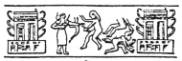
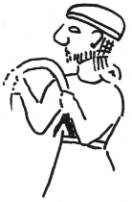
the cult of the great hunter seems to excel in a certain kind of cruelty. The
brutal butchering of prisoners is hailed as the work of the god. Here he supervises that the eyes
are put out on tied up prisoners begging for mercy[42]:

Instead of
wrestling with the lion or bull he can be seen wrestling with vegetation[43]:

The
hunter can easily be recognized on the heavy kilt and rounded hair- &
beard-cut. He is also on a seal from Susa seen in the act of (ritual?) shooting
down naked defenseless people in front of a temple. The cult-figure of the
hunter must be seen as a psychological attempt to draw power from the dark side
of the human nature.
At
the Anat-temple in Palmyra we find the big lion-sculpture:

Why
this gigantic animal with a strong underlining of the terrifying in its
appearance. Its eyes are not directed to the buck between its paws, but towards
heaven. What is the connection to the goddess whose temple it adorns? Anat is
the female hunter.
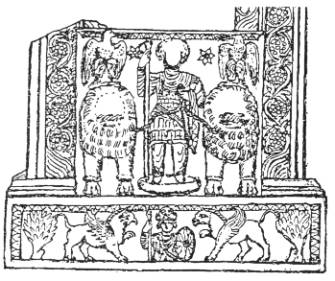
On this sculpture from the Helln.
period it is clearly seen, that the lionstrangler is not killing the lions, but
putting them in submission. The lions are symbols of demon forces tamed and
used by the magician. Acc. to an inscription[44]
the man standing between them is called “lord of the chained ones” (i.e. the
demons chained in the underworld).