21. Byblos: The marzeah
When the dead in Catal Hüyük was buried under
the sleeping platform, or as in the oldest layers in Jericho had his scull
remodelled to a face by adding plaster to it, this is a sure sign of honouring the
dead and having contact to the dead. Mellaart compares the fact that the scull
was often buried somewhere else than the rest of the body with “the
preservation of sculls” in the earliest Jericho [1].
From the Bible we know the polemic of the prophets against a spiritualistic
practice which seems to have been a strong undercurrent in Palestinian folk
religion:
“We have made a pact with Death and with the Realm of Death
for we have made Lie our refuge, seeking shelter in Delusion”,
are the words of the prophet's opponents, Is.
28,15. K. van der Toorn [2]
thinks that Lie and Delusion are distorted nicknames and stand for perhaps
Kemosh and Molok. A spiritualistic practise is hinted at by the mentioning of
squeaking spirits and he translates Is. 29,4: “And your voice (will come) from
the underworld like a ghost, and out of the dust your speech will chirp”. (The
spirits have taken the appearance of birds). Is.19,3b talks about questioning
“the spirits of the dead and the ghosts and the spirits of the forefathers”,
”who squeak and murmur”, Is. 8,19 [3].
J.Milik [4]
has given valuable descriptions of the Aramaeic marzeah, the thiasos
("drinking-lodge") where the god is thought to be present and
partaking in the meal and where the drinking seems to have been beyond measure [5].
Milik even thinks that the word soma, the old Indo Iranian drink of immortality
and intoxication can be found in a marzeah-inscription[6].
Milik is mostly working with inscriptions from Hellenistic Petra and Palmyra.
The marzeah was often rather small consisting of only 12 members or 12 & 6 acolouthoi (“followers”, disciples) and
a few musicians. There are pictures of naked women playing the flute (slave
prostitutes). Milik talks about a “système duodecimal de recrutement”[7].
But also the gods were invisible members of the lodge. An inscription talks
about an "assembly" consisting of “Bal, the sons of Nurbel and Allat”[8].
Atargatis was synagogeus for the
Syrian thiasoi at Delos.
The Ugarittexts mention the rephaim (spirits from times of old, in
the Bible from before the coming of Israel to the promised land). They are
summoned to eat and drink with the living ones at the threshing-ground. The teraphim “little housegods” as
protecting spirits cut out in wood or stone carry a name coming from the same
stem. In biblical time the spirits called upon were not so much the spirits of
the newly deceased as spirits from a far and distant past. The rephaim are
little spirits of fertility and this explains their names (rephaim =
“healers”). Like other demons they are living in and moving through “the air”
at which they arrive after a 3-day journey from the underworld. Like the cheres, little chaotic spirits coming to
Athens to celebrate the spring festival of Anthesteria and drink of the new
wine led by their Lord Dionysos, so the rephaim arrive from the realm of death
led by Baal to eat and drink for 7 days. It is especially Johs. de Moor who has
stressed this spiritualistic aspect in his translation of the Ugarittexts. He
talks about “spiritualistic sessions”, where the spirits of the forefathers are
called upon. It is Baal who at the New Year's feast brings the dead heroes to
life [9].
In the great Ugarit epos about the fighting of Baal his is finally enthroned on
the Mt.Saphon (the cosmic “Look out-mountain”) with the words: “Let them
install Ba´lu on the chair of his kingship” (Moor´s translation). After that
the rephaim are summoned to come, the sun being the one who has to lead them up
from the netherworld. Their leader is Baal, the rephait[10].
In his commentary to the Song of Songs in Anchor Bible Marvin Pope has collected a vast material to shed
light on the marzeah-meal and its presumed connection to the cult of the
spirits of the deceased. His very bold theories about dogs playing the role of
the dogs of hell, rapping sounds to keep evil spirits at a distance, the living
ones consuming the body fluids of the dead ones etc., have been criticised [11].
A more careful examination is Th.J.Lewis, The
Cults of the Dead in Ancient Israel and Ugarit, 1989 [12].
Lewis has especially dealt with an Ugarit text called (after his translation of
the first line):
“The Liturgy of the nocturnal
sacrifices” (literally: sacrifices of darkness). The second line Lewis
translates: “You are summoned oh heroes of the underworld” where heroes is a
translation of rfy (= rephaim). But
apart from the rephaim also some past and present kings are summoned, and the
king is invited to descend with Shapshu (the sun) to the underworld. During
this (ritual?) descent to the realm of death 7 sacrifices are brought - and a
bird (as sacrifice?). It is not possible to deny a strong connection between
the often rather rich and lodge-like marzeah institutions in the West Semitic
area and the cult of the rephaim (invited to marzeah, KTU I,21).
In the old Resheph temple in Byblos
was found a lot of small grotesque figures, mostly monkeys and baboons with
drinking cups in their hands, or holding their hands on the stomach, obviously
because of their eating or drinking too much. In Thebes in Greece were also
found a lot of grotesque figures painted on ceramics when the old buildings
belonging to the mysteries of the Kabires were dug out. (Ex.: Odysseus in a
very ridiculous appearance [13].)
They celebrate the presence of chaotic spirits and the ghosts of the heroes of
the past rising from the underworld. To understand the real nature of the
Adonis cult we have to understand the crucial words of Lucian about how the
feast for Adonis was celebrated in Hellenistic Byblos, and especially the word:
"Then (after weeping and mourning) after the third day they speak in
fantasy that he is alive and they send him up in the air (6)". Adonis
locked up in the nether world is not resurrected, but "sent up in free
air". The air is, as we have seen, the element of the demons and rephaim.
Probably Adonis is sent up into the air by the so-called desmofylax [14].
Byblos was dug out by Montet and M.Dunand. Since 2800 B.C. the city had two
main temples, one for Baalat, and one for Resheph. The temple for Resheph was
full of obelisks standing in the temple yard, in our opinion an assembly of
gods. Uranos invented, acc. to Philo of Byblos, "animated stones",
the so-called baityloi or Betels (bet
= "house", el = "god"). The many baityloi standing
in the sacred temple yard next to the holy lake are the souls of the leading
men of Byblos passed over into a state of eternity as "´ilim (=
gods)". In Ugarit "´ilim" is used as a parallel to
"rephaim". In South Arabia the standing stone-stele is called nfs
= "soul". Acc to Philo of Byblos, El Cronos = Resheph was surrounded
by a circle of "allied eloim (=gods)" (I,10,20). In their
hearts Hermes Trismegistos infused a magic inclination for killing.
A depot of sacrificial gifts
contained, apart from small statues of a very beautiful naked woman, a lot of
hippopotamus-figures. In the ancient world this animal was considered very
shameless because it "had no respect for justice" for it was supposed
"to kill its father and have sexual intercourse with its own mother"
(Isidor ap. Photios Bibliotheca [15]).
This must be the reason for such different figures put together in the same
depot together with a man whose sex is certainly not shown with any kind of
discretion (Dunand, catalogue no.15363-6, 15369, 15376). Dunand suggests that
the hippopotamus-figures should be seen in connection with the Egyptian
hippopotamus-goddess Tu-wrt (note that one of them has a protruding stomach as
if it is pregnant). But it is our opinion that the hippopotamus is a picture of
Seth. Wee shall later see, that killing one's father and marrying one's mother
is the typical "fight over the kingdom-of-heaven motif", and here
this behaviour is typical to the king of chaos, in Byblos represented by El
Cronos, with whom Resheph is identified. The little figure below is a hippopotamus
with arms and legs like a human, but with a crocodile hanging down its neck.
Both crocodile and hippopotamus are important symbols of Seth[16].
One picture shows a small baboon eating, or perhaps rather drinking, something.
Not all cynocephalic figures are baboons. One has obviously the body of a
human, and is also eating something. In our opinion they are symbols picturing
the participants in the orgiastic marzeah. All the above-mentioned figures are
found in the depots of the obelisk temple.
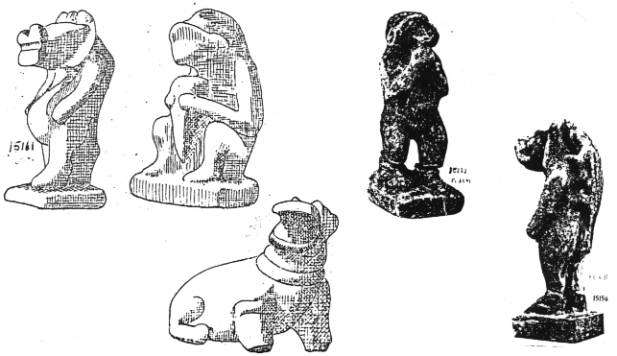
These figures witness to the very
important man-to-animal symbolism known from Catal Hüyük (man-to-leopard), from
Indo-European warrior-societies
(man-to-wolf), from Mesopotamian "Tierkapellen", from the
mysteries of Mithras (man-to-lion). The motif on the sacrificial knife shown
below is Adonis (the goat) chased by lion, baboon, dog, and a man riding a
donkey and armed with a curved stick. The animals are typical servants of Seth:
the donkey and the dog with long pointed ears. The baboon was a servant of
Anubis, the son of Seth. The fish finishing the row is, as we shall see later,
a symbol of the orgiastic meal (Dunand,pl. CXVIII 14442).
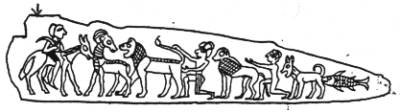
But why is Resheph/Seth putting his
hand up the lion´s but? Note the same gesture on the seal Dunand I, fig. 161,
no. 2497. It suggests a homosexual practise well-known from the Bible. (The
male prostitutes, Seth as well as Apollo are known for such inclinations.) That
the gesture is not accidental is seen from other small findings from Byblos
(Dunand, 7727 & 15715).
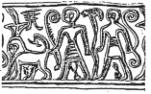
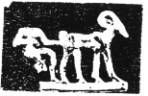
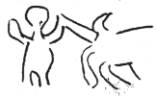
The sacrificial knife shows how
Adonis/Eliun (= The Highest God is attacked by a mixture of men and demonic
animals, who are really symbols of the marzeah.)
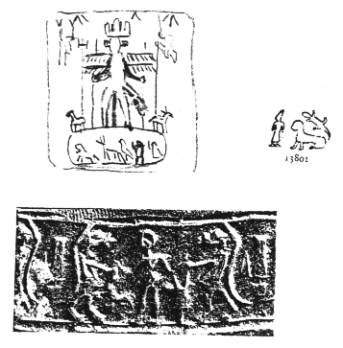
A little golden gem from Hellenistic
time shows El Cronos fitting the description given of him by Philo: with a
double pair of wings. He is standing between the two poles representing the
gate of the sun. They are not guarded by calves but by the characteristic
Seth-animal, a dog with long pointed ears, and he is standing on a cartouch
containing a lion, a Seth-dog, a bird of prey, scarab and uraeus-snake
(no.1248) A small motif from Byblos shows Baal-Resheph with his typical high
conical mitre followed by lion and crocodile. He is also shown as a man with a
dog (a hunter) taming two hippopotami with crocodiles hanging on their backs
(11464) – the typical "great hunter-dompteur" motif:
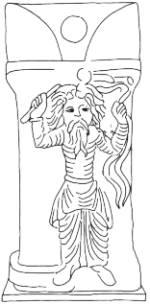
21.a. Resheph. The god
with a lion´s face
In Hatra there was a frightening god provided
with the face of a lion and with snakes protruding from both head and feet and
waist and axe. He was found in a temple that seems to be dedicated to the
spirits of the forefathers [17].
“Chapel no 10” in Hatra was dedicated to “Nergal, the dog”, and contained a pyræum with pictures of 3 dogs. Not only
lions/leopards but also dogs were symbols of the followers of the god of the
underworld, Nergal. Above he is shown in another version from an altar in the
same temple as the god with the Cerberos-dog. A seal from Ugarit [18]
shows the god with a lion´s face and two dogs hunting a stag and an ibex
arranged in a fourfold heraldic way, which, as we shall see later, makes them a
symbol of divine totality. His left hand is lifted to a gesture of adoration
(?) He is the left-handed hunter. A
picture found in a temple in Byblos shows Resheph (his name means "flame,
fire") with a lion´s face, enthroned next to Baalat.
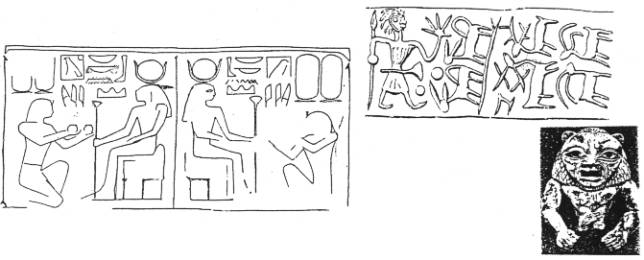
P.Montet,p.35,fig.6. To the right a tiny idol found in Byblos,
Dunand 15377.
Already H.Gressmann [19]
draws attention to the similarity between Melqart, the main god of Tyre,
Sandan, Heracles on Mt.Oite, and the god in Byblos in Egyptian texts called
Kaj-tau (= “who appears as the burning one”). All four gods are burnt (on
Melqart´s burning, see below). All four have something to do with lions
(Melqart on the Stele from Amrith). From the end of the first dynasty a
cylinder seal mentions the gods from Byblos: Hathor, "the lion",
"Re of the mountain", and finally "the god with the two lions,
Kaj-tau". The last mentioned has often been identified with Adonis, but it
seems much more logical to identify him with Resheph, to whom the main temple
of Byblos was dedicated. Together with his female partner Hathor/Baalat this
Resheph is the main god of the city. He is identical with the cruel El Cronos
in Philo of Byblos´s description of the early history of this town. He is the
demonic hunter pictured in the classical position of taming the two lions. His
genius, his helping spirit, the lion, can be worshipped as an independent god.
And as the god who has completed his journey in the course of the sun and
reached the mountain of the gods (see
below), he is also "Ra of the mountain". That the god with the two
lions is identical with the god "Ra of the mountain" can be seen from
an inscription found in a church near Sidon [20].
This Greek inscription is sponsored by a man, who, after a dream, dedicated two
lions to Zeus Oreios (= "Z. of the mountain"). In other texts he is
mentioned as Baal Gebal (Gebal is the Semitic name for Byblos, and means
mountain). P.Montet [21]
identifies Kaj-tau with Bata and Adonis, but makes no attempt to identify
"Ra of the mountain lands" and "Ra who is on Pharao´s
lake", two designations also given to a god from Byblos in Egyptian texts [22]
But he mentions that the "Lake of Pharao" could be the round lake
which is situated next to the old Resheph temple in Byblos [23].
Resheph is also called Ruti ("of the form of a lion") and a divine
child is spoken of as "child of the lion, child of the Ra of the foreign
countries" [24].
Many coins from Byblos show a lion
killing a stag. This is cryptogram for Resheph/Ares killing Adonis, the
highgod, the god of vegetation. The battle scene between the lion of the
burning heat and the bull of the vegetation and the moon is also seen in South
Arabia, and M.Höfner has given the right interpretation of the motif [25].
The motif is also found in Byblos on jars of clay (Dunand, 11572):
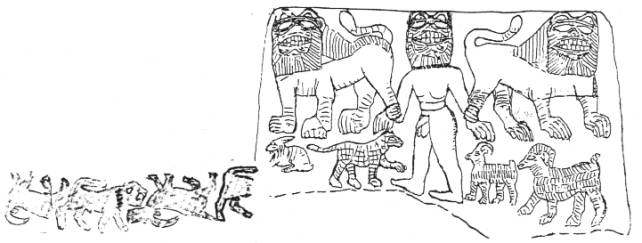
God
with a lion's face taming lions. From Tell Mardikh [26].
From Max Mallowan´s diggings at
Nimrod comes the small sculpture below showing the killing of the god of
vegetation. He is killed in his own domain, a thicket sprouting with fertility
and beautiful flowers. The lion killing him carries a "third eye" in
her forehead, she is not only the symbol of sunlight and heat, but of mystical
light. Max von Oppenheim [27]
thinks that the lion in the prehistoric Tell Halaf was a symbol of the sun god.
But in our opinion it was originally the symbol of Orion. For two months during
the spring, Orion sinks under the horizon and then it will rise and resume its
hunt for Taurus, "the bull". The lion is also seen on a seal from the
Djemdet Nasr-period in Ur. Horses playing different instruments are performing
in front of the lion-hunter drinking together with the god of vegetation
represented by the gazelle, but in the background the lion is stabbing the
gazelle. "Die Tierkapellen", the groups of animal-musicians,
"are picturing some kind of orgiastic feast for the sun" acc. to
Freiherr v Oppenheim.
Coins struck already under the satrap Mazaios 351-334 B.C. show a
club and a lion killing a bull, both club and lion being the symbols of
Sandan-Heracles. On coins from 164 B.C. Sandan is standing on a lion with his
hunting-bow and with his double-axe in his left
hand and the mystical flower in his right, on the reverse the club and the lion
killing the bull [28].
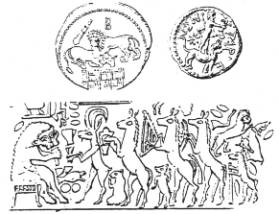
L.Legrain, Ur Excavations III,
pl. 21 No. 384
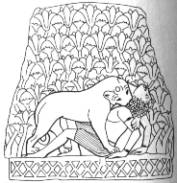
Ivory
8-7.cent.B.C. Height 10,5 cm Brit.Mus.London.
That the lion is a symbol of the
heat of the sun is clear from both texts and pictures. "I am the lion,
with wide open jaws, of the god Utu (the sun)", says a text from the Ur
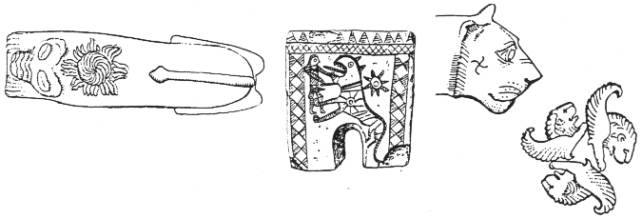
III period [29]. Many lions
are seen with the symbol of mystical light, the flower with eight petals, the
symbol of light concentrated in mystical vision. First a lion with a whirl with
eight beams on its back (from the king´s palace in Mari 1st half of 2nd mill.
B.C.). The next lion is from Gezer [30].
A lion from Teheran, the pre-Achmenid period, carries the swastika-sign on its
behind, its shoulders and its breast, even on the cheek [31].
The swastika may turn into a whirl of lions [32].
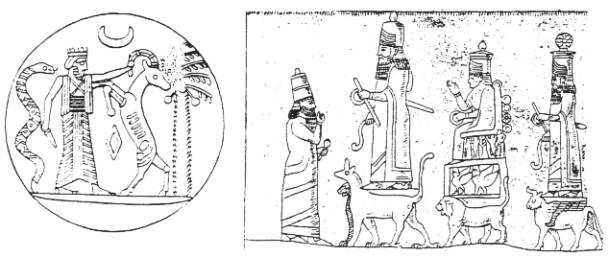
But also the hunter may be shown as a swastika-whirl (seal belonging to
Mesannipadda [33]). Coins
from Beirut under Gallienus show a lion with a light-ball over its head [34].
On a fresco from Minoan Thera the young god arrives onboard a ship and is
received by the queen or goddess. His ship has a lion´s head in the prow and is
accompanied by lions and dolphins, cf. the Homeric Hymn to Dionysos where Dionysos is changed into a lion, the sea
robbers trying to kidnap him are changed into dolphins, and he arrives in
Athens for the Anthesteria (the spring festival) on the ship which is also
carried in procession. Notice that the young god has a very peculiar whirl on
his forehead. This hairdo is also found on the god on the Hagia Triada
sarcophagus and on a gem [35].
It represents either the lion's mane or marks out the third eye as power-emitting.
The mask of a baboon with a third eye is found at Bet Shan [36].
The ship with the lion's prow and the dolphin is a common motif also on coins
from Tyre.
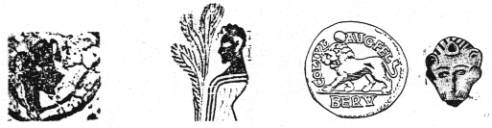
Acc to some scholars the picture below
shows the dying Adonis. The bed is guarded by two lions who have both killed a
goat or a gazelle. Tritons carry the
bed, functioning as legs, and under the cushion there is a dolphin. At the
god´s shoulder a woman with her hair let down, carrying a drinking vessel and a
pitcher. H.Seyrig sees the woman as mourning, offering Adonis the drink of
life. But in our opinion it is much more likely that the scene is a symbol of
the god´s orgy. He is the great hunter, Lord of the thiasos whose chaotic character
is stressed by the flowing hair of the serving woman, the drink, the killing
lions. But the god is dressed in clothes not suitable for a hunt. The same
ornament is found by Seyrig on a picture of a dress belonging to Helios. The
hunter with his two lions has become one with the sun warrior (SYRIA 27,1950,p.230, drawing by R.Amy):
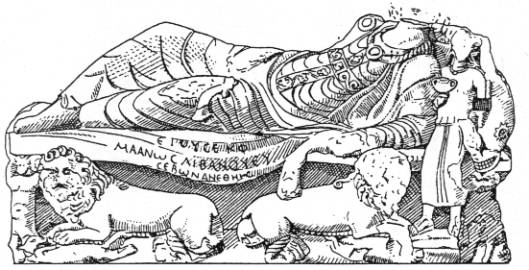
Dunand no. 19041 is the upper half
of a small broken slab. It shows a man with a lion´s face. The monster is
standing with his back turned to the spectator and in his left hand he has a
hind leg of a small animal. His face with snarling jaws is turned to a big
snake, whose head is only dimly seen. All along the edge of the slab is another
snake with a cleft tongue. On the reverse a ram. The demon lamassu is well known from the Assyrian palaces. It is a man with a
lion's face and the ears of a donkey. It is a demon with both violent(lion) and
shameless (donkey) inclinations.
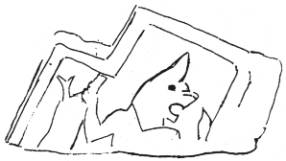
A human being with
both feminine and masculine sexorgans is called a lamassu. He is the picture of the androgyne nature of the great
hunter. It seems obvious that such creatures in Assyria are connected to the
goddess Ishtar, goddess for both love and war, both warrior and harlot. Her
nature is aptly described by R.Harris [37].
She loves the war: “You pile up heads like dust”, it is said of her. She likes
to clean her tools in the blood of war, war is a feast to her. She is also
harlot and mistress, but no nurse or weaver – the common female occupations.
This unites in her the two potential areas of violence and chaos: WAR &
LOVE. She likes to play with people and her playground is the battlefield. Her
believers cling to the old confession of libertinism: There is no world-order,
only an absurd game and the destructive lust of the players. It is even possible
that her cult personnel had the habit of talking in a funny-chaotic way
(“chirping”, ”twitting”). Pornographic language and ritual obscenity
characterise the so-called love lyrics which were recited at the feasts of the
goddess. They were feasts of disorder and anti-structure where normal order was
turned upside down both in respect to status, age and sex (“institutionalised
license”). Of her cult-personnel was expected a quite specific behaviour like
from Pierrot and Harlequin on the stage. One gave oneself to forbidden acts to please
the heart of Ishtar. The lion men wore their masks in her honour. There was
also acting of men dressed in women´s clothes. For Ishtar was she, who “turns
the left side (the female side) into the right (the male)”. “She turns man into
woman”. She is androgynous and coincidentia oppositorum.
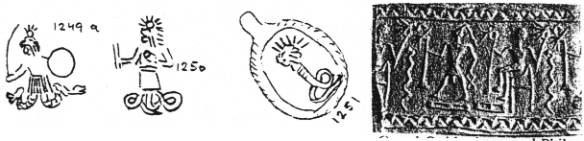
A small treasure of 8
pieces of gold jewellery was found in Byblos (Dunand 1248-54). One of them
shows the typical JAO-figure: A warrior with the double snake as feet and the
head of a cock – a god illustration to the word of Johs. Lydus de mens 4,53 that JAO in Phoenician
meant supernatural light (phôs noêtos). On the top of his head a ball of
light. But also the god with the face of the lion can be a symbol of the
supernatural light seen when the coiled kundalini-power is raised. No.1250
shows a man with a lion's head and 7 beams from the light ball on his forehead
(the mystical sevenfold light) and a double beam from his eye. The jewellery is
from the late Hellenistic period, much younger than the seal of the lion man
killing the bull-man, Dunand 10654.
But also in the
earlier period a kundalini-symbolism was surrounding Resheph. On the last
picture he is seen standing before a man enthroned on a seat. Behind the man
the kundalini snake rises in seven curves. Both Resheph and the enthroned has a
kind of instrument in their hands, a sceptre with the mystical lotus (Dunand
7169):
Lucian has a boar as
the animal killing Adonis (de dea 6)
and Ovid a bear, and Philo talks about an encounter with wild animals. The
building named “Batiment 1” by Dunand is probably a temple for Adonis and a
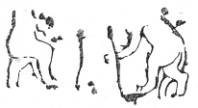
stele with the motif below was found in it. A mighty lion (to judge from its
long tail) has risen to its hind legs against a human (Adonis) totally worn away.
Behind him a woman is sitting (the goddess) Dunand I,fig.51:
The Hindu god Vishnu
can act as narasimha (“Man-lion”). In
this role he is able to kill Hiranjakasipu (“He who is sitting on the Golden
Carpet”) who is the archetypal ascetic. In 11500 years he has practised
austerities and by this he achieved invulnerability being all gods and powers,
sun, moon, wind, fire, water, space, stars, and the primeval affections, anger
and lust (Brahmapurana 213,44-79).
In an overwhelming
multitude, small idols of Resheph are found in the depots of his temple. On
most of them Resheph can easily be recognised on the axe he carries. Also this
item is found often richly adorned and gilded with gold. The vast majority of
the idols pictures the god as stark naked and very tall and slim with the
characteristic cone-shaped mitre. The high, pointed hat, the long straight
legs, the yellow colour of the bronze (in some cases gilded with gold) makes
the god look like the flame hinted at by his name. The character of the god is
also seen from the many weapons given to him and found in the depots of his
temple.
One of the axes
carries on one side of the blade the ram of Adonis, on the other the grey hound
of Seth-Resheph (14434). The main export of Byblos was timber, so the main myth
of Byblos must have been the myth about the great woodcutter as the main myth
in the seaport Tyre must have been the myth of the first attempt to sail the
sea.
On another axe is
seen two baboons climbing a high pole (Dunand II.fig. 422,p.391).
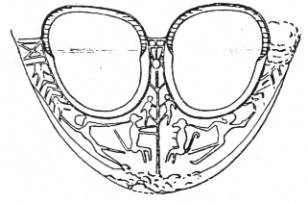
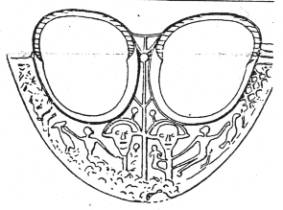
Such tree-climbing contests must have been
common among the lumber-jacks. But here two baboons are trying to ascend with
the help of Resheph with his hand fusing energy into their necks and taking
this energy from seven small pyramids. The ascension is an ecstatic one over
the sevenfold world mountain mentioned in the Gilgamesh epos. The baboons and
other animals with a protruding nose are well known partakers in the marzeah of
Resheph as seen above. The reverse shows Resheph taking energy from the bird of
ecstasy putting it into the divided and personified world pillar.
Another very richly
decorated axe shows the two bullmen putting up the gate of the sun (16701).
Behind them are seen the kundalini snake and the symbol of the night and the
highgod. (The moon between the morning and the evening star).
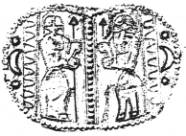
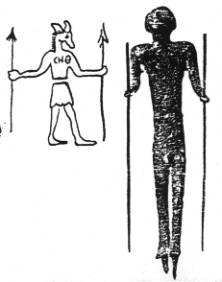
But mostly it is Resheph who puts up the gate (2015). The
eyes lifted towards heaven could be a sign that he stands in the gate to the
supernatural. In late Hellenistic time he has become one with Seth and is seen
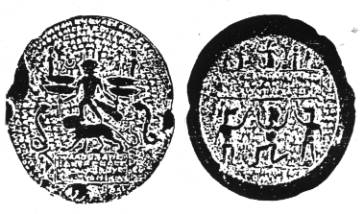
on an amulet [38]. Already on
the small scarabs he was pictured winged and standing on a lion or with two
uraeus snakes. This makes it possible to see a continuation of his iconography
in this magical amulet also showing him with the two poles of the gate of the
sun, the fourfold wings of El Cronos, and standing on the lion. On the reverse
he is seen in the same function lifting heaven from earth with the help of two
dog-men. In heaven is seen the symbol of totality JAO with the double snake as
his legs (C.Bonner,fig.395)
El Cronos, acc to
Philo the main god of Byblos, must be identical with Resheph whom archaeology
proved was the main god of the city, and El Cronos´s attack on his father,
Uranos, is exacted because he wants to separate Uranos (“Heaven”) and Earth,
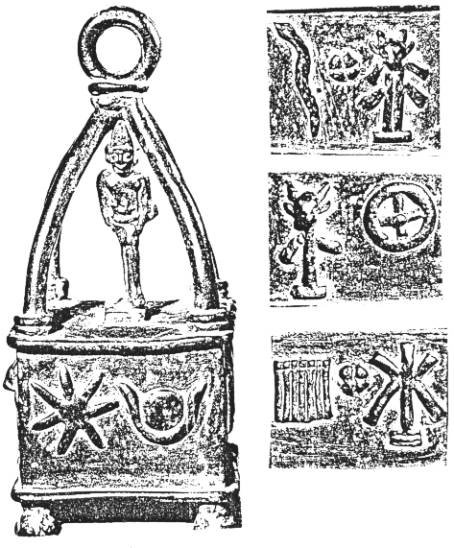
Uranos’ wife, because “Heaven always wanted to embrace Earth”. A small bronze
casket is seen to be an exact copy of the famous Sandan´s Pyra, but the god taking
Sandan´s place is Resheph [39].
In our opinion Resheph (and Sandan) is pictured as the one who creates space
inside the primordial mountain. Typhon, the snake coiling together into
amorphous matter, is trying to suck the world back into a massive rock of stone.
The little shrine is filled with mystical symbols: the old bull on a double
pole and with an ascending snake, the young bull on a single pole guarding the
wheel of the sun, the mystical rosette with four petals and a pole standing on
a three stepped platform carrying some symbol of centre and in the background a
7-fold pole. There is clearly a 3-step movement from one to two to 7 or 8-fold numen.
Acc. to Philo El
Cronos had a double pair of eyes and he was the first to perform the sacrifice
of a child. A Phoenician god with a double face is found on a stone relief in
the ruins of a stone tower from about 500 B.C. south west of Valencia in Spain.
The ashes in the tower show that it was used as an oven for cremations.
Ch.Kennedy [40] thinks that
two small figures are children sacrificed to the death-god in some kind of
cannibalistic meal:
“The relief shows a banquet prepared for a two-headed monster with the body of a human. He sits to the left of the scene on a throne with a fringed cushion or covering for the seat. The two heads of the monster are set one above the other, with large eyes, mouths open and tongues extending out and downwards. In its upraised right hand is a bowl. Over the rim of the bowl can be seen the head and feet of a small person with its head turned to look at the upper head of the monster. The monster’s left hand holds the left hind leg of a pig which is lying on its back on the table in front of the throne. Behind the table stands a male figure wearing a long fringed tunic or robe. He raises a small bowl in a gesture of offering. The right-hand panel is broken, but enough remains to show a third figure facing the monster across the table. This figure appears to be standing also, its upraised right hand holding a sword with a curved blade. The head of the figure, only partially preserved, is shaped like that of a horse or bull. Whether this is supposed to be an actual head or a mask cannot be determined. The left hand of the figure reaches forward to touch the head of a second small person in a bowl atop a low altar located alongside the banquet table”.
We have already seen
that Osiris carries the two feathers of El Kronos and the cone-shaped hat of
Resjef. And as Djed-Osiris he is the worldpillar. We think that Osiris was some
early hunter-type from Byblos. Planks of a length of 6o feet are used in the
grave ships of king Cheops, but some of the trees cut down at Byblos were 60
yards.
The Egyptian word Kbn
(later kpni) used about a place where
there was a multitude of cs-tree and a
centre for building ships was first examined by F.Chabas (Voyage d´un Egyptien en Syrie, 1866[41]).
He saw the word as coming from Semitic Gabaon/Gebal
– k and g are often mixed up when Semitic is transcribed into Egyptian and l is non-existent among the Egyptian
sounds. Very early Gebal (in Greek Byblos) had an important role to play in the
Egyptian mind. P.Montet [42]
has paid attention to some magic formulas which seek to identify the mummy of
Pharaoh with Osiris, but to prevent him from some of the dangers that hit
Osiris: “that you should not be treated like Him in Negau, that you should not
be changed into a spruce”. What is feared is the transformation of Osiris into
the pine growing up and encircling his coffin as told by Plutarch in a much
later text.
In the oldest period, Pharaoh carried as his
sign of dignity a sceptre with the red donkey-ears of Seth on top of it. The
earliest pyramid texts from the pyramid of Unas has the famous cannibalistic
section: The dead Pharaoh is hailed as the one who eats his own parents,
becomes a god, slaughter and eat gods whom he has first cut up and thrown into
a bowl for cooking and finally ascends to heaven as the mighty Orion [43].
By this strange meal Unas is able to integrate both the power and the
intelligence of the gods in his human existence, he gets eternal life and can
do whatever he pleases.
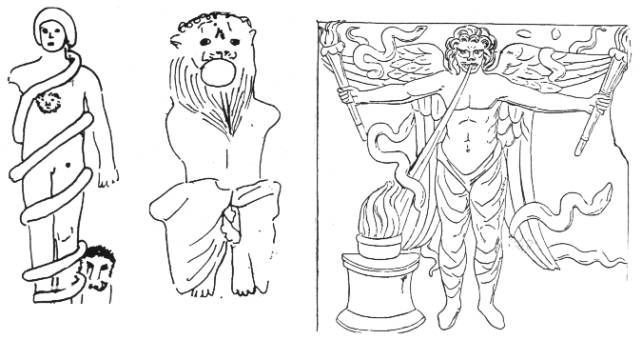
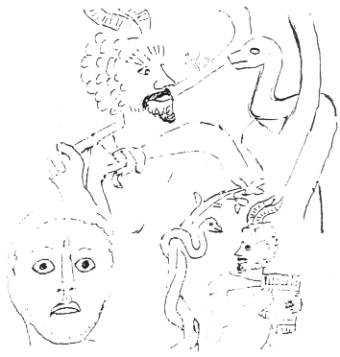
Much later we will
meat the god with the lion-face in caves of Mithras, where he is called Saturn
or even Arimanios (the Persian name for the devil). Here his most common
feature besides the lion-face is the snake coiling around his body. The
drawings below show him identified with Adonis (1), as a lion-god able to spew
fire out of his mouth (2 & 3,Cumont
MMM, p.196, drawing after the description of a now lost monument found in
Rome), with a “third eye” not on the forehead but on the breast (4), without a
lion's face but as the mummy like death-god (5, Syrian god from Janiculum in
Rome [44]).
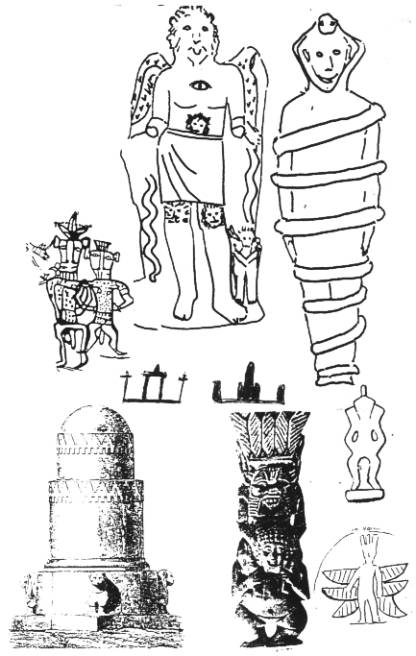
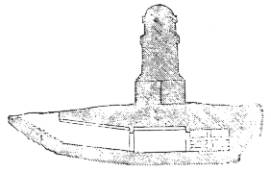
The origin of the god
with a lion face found in the Mithraea has been the objects of much discussion
but already W.Bousset has pointed to the Syrian Saturn/Cronos. At an early
stage the Syrian god with the lion's face was identified with the Egyptian god
Bes. At Kuntillet ´Ajrud were found
some painted store jars[45]
with pictures of Bes dressed in a kind of tight T-shirt full of dots probably
imitating the spots of the leopard (not apotropaic eyes as some scholars
think). The strange triple device on his head is typical for Bes and marks him
out as world pillar. On magical gems it is clearly seen that the triple devise
is the world pillar flanked by the Heracles columns.
Coins from Byblos
show El Cronos with a triple arrangement on his head[46].
The name of the
planet Saturn is in West Semitic KVN, "standing firm" "standing
upright" (about the world pillar) and its importance to the West Semitic
notions about life after death could not be exaggerated. In Greek the word is
taken over as kiôn =
"pillar". We find the Saturn-pillar guarded by 4 lions raised over
Phoenician tombs[47], and in
Mari the temple yard next to the great temple-tower was full of stone stelai,
symbols of the world pillar as the ladder to heaven and as the symbol of the
primordial paradise mountain, an eternal dwelling place for the deceased's
soul. The Gnostic term for salvation (stêrizô)
means "to make one stand firm" (eternally standing) and may have some
connections to these West Semitic notions (and to the heavenly council of
angels eternally standing in the presence of God).
The Saturn pillar is
decorated with the stepped pinnacle and a zigzag pattern symbolising up and
down, left and right weaved together: duality is overcome. On some pictures of
Bes he is carried by his wife Besit and the broad polos adorned with vegetation makes him world pillar. Notice the
androgynous nature of the pillar[48].
A small pendent from Byblos shows Bes as the triple world pillar[49].
21.b. Eros and Pothos
Acc. to Philo these were the two
sons of Ashtarte. Coins from Paphos on Cyprus show the goddess as the world
mountain flanked by the morning and evening star. On Greek vase painting the
car of Aphrodite is drawn by Pothos and Himeros. One of the boys is carrying a
wreath and a flat bowl with water, the other a miniature fire-altar.
I.Cornelius has collected no less than 12 representations of the stark naked
goddess standing between two gods mostly Min and Resheph. She gives a snake (or
double snake) to Resheph at her left hand and lotus flowers to Min[50].
One[51]
shows her still naked, without snakes and flowers, but flanked by two minor
figures, one carrying a symbol of vegetation, the other carrying an axe, and
with the symbol of mystical light over his head.[52]
Now, what is the meaning of this very specific motif?
On a terracotta plate
from Athens the goddess Athene is shown as a snake-goddess. A snake is rising
at her left hand, coiling up between 7 (?) rosettes. At her right hand another
snake ascending between lotus-flowers[53].
Acc to ancient tradition the kundalini power is lost when the semen is lost.
Now, the Erichthonios-child was born by Hephaistos dropping his semen on the
earth while pursuing Athene in a vain hope of having some pleasure with her.
The child was hidden in a box carried by the daughters of Cecrops. When they
opened the box, they went mad by the sight of the divine child with two snakes
coiling around it.[54]
Both Erichthonios and Athene are old personifications of the kundalini-power.
The Medusa head on Athene´s shield is the kundalini in its more terrifying
aspect.
The same must be said
about the naked goddess. Note the two snakes coming out of her polos and
joining the wings of the mystical bird.
The mystic vision
seems to have both an aspect of overwhelming beauty (the lotus opening its
shining flower) and an aspect of terror (the snake staring into the eyes of
Resheph). The sweet side is linked to the god of life and vegetation, the
terrifying to Resheph, the god of killing. A cult standard has been dug out in
Hazor: it shows the face of a woman between two ascending snakes rising towards
a shallow bowl in which is placed something round or coiled, acc to Y.Yadin the
motif must be seen in connection with the goddess Qudshu[55].
The Qudshu character´s undisguised nudity makes her identical with the naked
woman often seen on the seals descending from heaven on the back of the bull.
She is the representative of a descending and ascending female divine power,
also known from the much later gnostic texts where she is called Sophia. In the
Orfic cosmogony she is called Metis with the son, Poros, and Eros as her
grandson, and Athene as her daughter. She has been swallowed by Zeus, now
living inside him, providing him with good “advice”. The birth of Athene from
the forehead of Zeus (by the stroke of the hammer of Hephaistos) is creation by
seperating the female kundalini-force from its inactive, mystical state of
being united to the male god. In his famous book Hellas W.Grønbæk has shown that the cultic act behind this myth is
the killing of the sacrificial bull by an axe as an act of creation/recreation
of the town Athens at the festival of Buphónia.
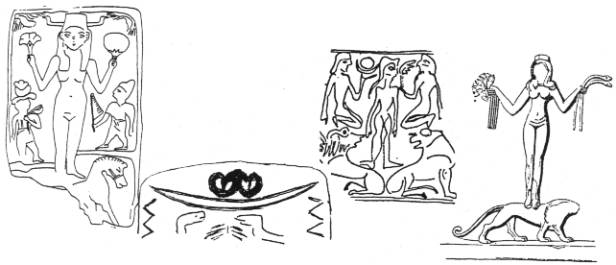
Athtart from Ugarit between the two rivals (RS 5089,1450-1365 B.C.).
Right: A.Layard's drawing of the motif.
21.c. Born by incest
Acc. to the teaching of the Magi Ohrmasd created
the sun and the moon by an incestuous act with his mother and his sister. Only
in this way the light could be created. Ohrmasd actually was unable to create
this vital part of his creation without the help of the demon Mahmi, who taught
him the dark secret of the magic value of the incestuous act. There are even
some signs that the stars were created by Ohrmasd making love to his daughter.
It is strange that this kind of marriage among the Magi praised as the most
ideal kind was seen as originally the idea of Ahriman a magic knowledge this
devil tried to hide from Ohrmasd.
Now the incestuous act is a most
important way to mystic vision and light in left hand tantra.
Zaehner [56]
draws our attention to a similar myth in the Mandaean myth of creation: Ruha
first made love to her son Ur as his mother and gave birth to the seven
planets, then comes to him in the body of a sister and he generated with her
the 12 signs of the Zodiac and finally she showed herself to him in the body of
his daughter and afterwards gave birth to 5 giants who are the 5 planets
without sun and moon [57].
But this myth is not an invention of the Magi because we find it in Anatolia in
the myth connected to the birth of the god Sabazios. He is born by Persephone
after an incestuous act with her own father Zeus.
The name shows that Ur is the great
hunter: Orion, Geryon are both names derived from the Westsemitic ´Ur, “The
Burning one”, cf Er who in Plato´s myth wakes up on his own funeral fire
(Sandan on the big bonfire). Cf. the South Palaestinian Ares/´Ara, the
Mesopotamian Irra/Girra.
D.Chwolsohn has [58]
collected some material on this name, who in the form Aru or Uru can be found
on a list of gods from Harran. He is called Aru “Lord” (Baal/Bel) and is
therefore probably the partner of the following name the goddess Balthi, just
like Resheph (“the Burning one”) is the partner of Baalat in Byblos. Chwolson
also mentions Areu, Armenian for
“Sun”, Neo-Persian Hur/Chur. Acc. to
Cicero [59]
Jupiter was called Urios in Phrygia. A hero from Thebes was called Aristaios.
He is by Nonnos called agreus =
“hunter” and hailed as the inventor of cubes for bees, the raising of cattle
herds & the hunting boots. When the dog star rises in high and hot summer
the winds whisper that the time for the Aristaios-sacrifice has come, a
sacrifice whose purpose is to call upon the winds which can avert the fever
sent by Sirius.
The myth about Adonis tells in one
version how Myrrha gave her father Kinyras plenty to drink and slipped into his
bed. When he realised, what had happened he pursued her without mercy and when
he caught up to her she was changed into the myrrh-tree and the father struck
her with his axe but only hitting the tree. The bark was cut into two and
revealed a small child, Adonis. This is a new variation of the Byblos
woodcutter myth which we will deal with in a moment. The great hunter is often
pictured as drunk (Orion, Agdistis). That some sexual sin is committed under
the influence of alcohol is a faint trace of the orgiastic symposion of the
Great Hunter. In Byblos he is Resheph with the axe (W.J.Fulco[60]
mentions “pole-axe” & “fenestrated axe” as the weapons of the god)
attacking the god of vegetation, who in the moment of death is transformed to
new modes of existence or reborn. That Kinyras (Hebrew kinnor = “lyre”) is Resheph, is confirmed by the fact that Resheph
is often pictured with a lute[61].
The lute is a part of the ecstatic nature of this god, an ecstasy created by
music. During the Seleukidic reign the great hunter was identified with the
Greek god Apollo and to his temple in Daphne outside Antioch was attached the
myth about how the god pursues the young girl Daphne (the laurel tree) who to
avoid him sends her prayers to mother Earth, who changes her into a tree. This
Apollo is often pictured on Syrian coins and the way he holds up his bow is
found also on Parthian coins and perhaps it goes back to Assyrian hunter:
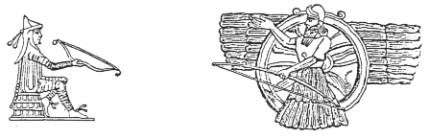
E.Babelon,
Numismatique de la Perse Antique I, par
J.de Morgan. fig.2, p.87, 3.cent. B.C. Drawing by Austin
Layard
21.d. An old holy weapon
carried by El Cronos of Byblos
Acc. to Philo of Byblos El Cronos won his
kingdom in battle with Uranos by the help of the "sickle sword". The
sickle sword was carried as a sign of authority by the king in Byblos. This
sceptre of bronze & silver with inlaid iron has once belonged to king
Ip-shemou-abi. 18th cent. B.C.
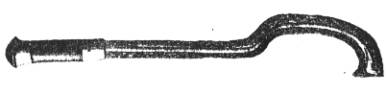
The hunters in Catal Hüyük are armed
with throwing clubs and bows. The throwing sticks continue to be the holy
weapon of the gods. It is seen in the hands of Marduk (by German scholars
called "Krummholz"), Gilgamesh, Martu, it is carried by high
officials in Etruria and it is the Roman lituus
carried as a sign of honour by high-ranking religious personnel. In
Old-Anatolia it is seen in the hands of gods and often by German scholars
called "Hasenschläger" ("hare-killer").
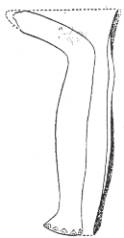 G.Maspero draws our attention to the
fact that the Egyptian hieroglyph
G.Maspero draws our attention to the
fact that the Egyptian hieroglyph  expresses “all the ideas of violence and of
brutal force”[62]. A
boomerang in mini size of red jasper was placed on top of the mummy to be its
weapon in the next world[63]
and a boomerang belonging to the prehistoric Badari culture is shown to the
right[64].
Characteristic to TheBadarian
civilisation, dug out by Guy Brunton & G.Caton-Thomson, were the
strange ox-burials[65]
indicating that the ox was already a holy animal. "The Badarians were a
fellow branch with the Indians both radiating from some Asiatic centre"
(Brunton[66]). Could
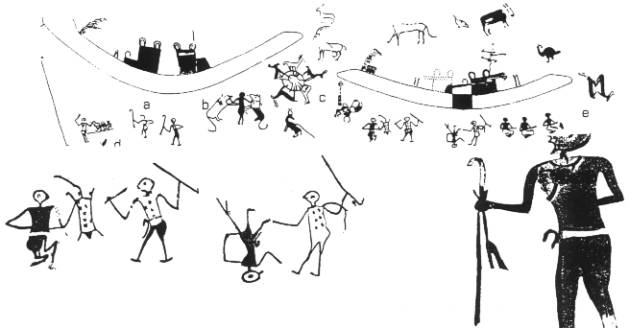
this be East Anatolia or the Halafian culture? From a grave in Hierakonpolis in
Upper Egypt we have a very early example of the lion-dangler (b), ships, a
whirl of horned cattle (c), bound prisoners being clubbed down in front of two
men with throwing sticks or curved clubs (a), and we even see a double gazelle
(e) as we shall see the very symbol of divine totality. If we enlarge certain
details of this scenery we will see that the warriors are fighting with shields
and breast shields made of leopard's skin. Most of them are armed with two throwing
clubs, one in the hand, the other hanging from the belt. They also carry a
short fork-like device, obviously a stick to prolong the arm when throwing the
club. Now the leopard's skin and the curved throwing clubs are typical of the
hunters of Catal Hüyük. The belt and the ritual nakedness complete the
appearance of the Egyptian warrior.
expresses “all the ideas of violence and of
brutal force”[62]. A
boomerang in mini size of red jasper was placed on top of the mummy to be its
weapon in the next world[63]
and a boomerang belonging to the prehistoric Badari culture is shown to the
right[64].
Characteristic to TheBadarian
civilisation, dug out by Guy Brunton & G.Caton-Thomson, were the
strange ox-burials[65]
indicating that the ox was already a holy animal. "The Badarians were a
fellow branch with the Indians both radiating from some Asiatic centre"
(Brunton[66]). Could
this be East Anatolia or the Halafian culture? From a grave in Hierakonpolis in
Upper Egypt we have a very early example of the lion-dangler (b), ships, a
whirl of horned cattle (c), bound prisoners being clubbed down in front of two
men with throwing sticks or curved clubs (a), and we even see a double gazelle
(e) as we shall see the very symbol of divine totality. If we enlarge certain
details of this scenery we will see that the warriors are fighting with shields
and breast shields made of leopard's skin. Most of them are armed with two throwing
clubs, one in the hand, the other hanging from the belt. They also carry a
short fork-like device, obviously a stick to prolong the arm when throwing the
club. Now the leopard's skin and the curved throwing clubs are typical of the
hunters of Catal Hüyük. The belt and the ritual nakedness complete the
appearance of the Egyptian warrior.
A.Grohmann
has shown in an important study Gottersymbole
und Symboltiere auf Sudarabischen
Denkmälern (1914) that the same symbols are found in Mesopotamia, in the Minoan
culture of Crete and in pre Islamic South Arabia. This goes for the cross and
the throwing-stick (or curved club, Grohmann calls it the
“Totschlägersymbole”). Both symbols are known from Catal Hüyük, but the hunt on
the bull has in South Arabia survived as the famous Attar-hunt on the ibex. In
Roman times the sacred hunt becomes Mithras hunt on the divine bull, but long
before that we find a Persian warrior stabbing the holy ibex feeding on the
tree of life under the crescent moon. That it is a symbol of mystic vision can
be seen from the kundalini-snake raising its head behind the warrior.
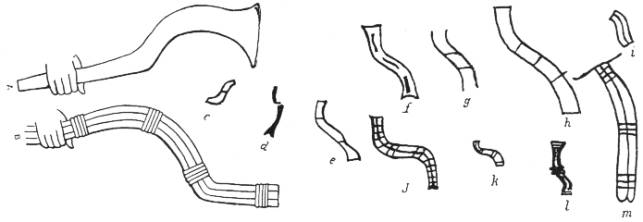
The Sumerian hand weapons A & B are from
P.Handcock, Mesopotamian Archaeology, pp.341ff.
The
Roman mysteries of Mithras are a variation of the old marzeah. In the presence
of the god Saturn with the lion face and the big snake coiling around his body
ascending to put its head as a third eye on his forehead, the members of this
secret society meet in the underworld cave-like temple to meditate on the
killing of the divine bull and drink a sacred drink seen as the sperm of the
bull emitted in the moment of its death. The bones of different
animal-offerings are found in the caves. Of special interest for our theme is
the presence of wolf-bones.
The curved stick has a long
afterlife in the holy hunt. On the memorial of L.Poblicius, a Roman officer
whose grave-monument was dug out of the underground in Cologne, we find scenes
from a holy hunt: a maenad dancing with the back part of a small deer torn into
pieces and a Pan with a hare and a pedum,
a curved stick, as his weapon, looking deep into the eyes of a snake coiling up
a tree.
The monument now in
Römisch-Germanische Museum, Cologne:
In some traditions not the curved
club, but the curved scimitar, (in Greek: Harpe
after a Semitic loanword hæræb) will
be the holy weapon par excellence in the hands of gods and demons. With such an
instrument is Typhon brought to its knees and it is found in several royal
tombs in Byblos. It is the "most characteristic" grave gift, acc to
P.Montet[67], who was
the leader of the diggings. The first was found by Virolleaud and described in
1922 in SYRIA[68].
In some of the royal graves from
Mesopotamia [69] are found some
strange saws. A. Moortgat thinks that the grave PG 789 in Ur was opened by the
help of chisel and saw and the dead king symbolically liberated from the grave.
The body of the king is missing although there have been found the
bodies of quite a lot of his servants. A totally rotten wooden coffin was
standing over a hole in the vault over the grave and spread around the hole
were precious pieces of dinner service of gold and silver for a meal and a
large container made of steatite containing drill, saw, and chisel in copper
plus a saw and a chisel in gold. As this is certainly not the grave of a
carpenter; how come then the presence of these tools? And how can chisel and
saw in such a soft metal as gold, be anything else than a symbol? The saw is by
Moortgat set into connection with the instrument held by the sun god under his
liberation from his grave in the underworld at the moment of his rising in the
East. With his holy saw he cuts the world mountain into two. Note the two
paradise-trees standing on top of each of the two mountains. They are like the
pillars of Heracles symbols of duality and therefore made into opposites, one
being tall and slender the other short and square (Frankfort, pl. XVIII a). The
sunrise out of the imprisonment in the realms of death is the great symbol of
resurrection and eternal life. In Byblos the hárpê sword seems to have taken
over the role of the saw as the weapon of the sun hero. Philo of Byblos tells
about El Cronos of Byblos that he was given the hárpe-sword by Hermes Trismegistos
and with this weapon he killed his own son Sadidos and decapitated his own
daughter.
21.e. Other Woodcutters
and the axe of Resheph
The hunter attacking the tree is also an attack on the god of vegetation, who in Anatolian art can be seen as a centaur. The picture below seems to show the common motif, the primeval fight between the two brothers, a symbol of duality emerging out of primordial unity. The god of vegetation with a tree in his hand is attacked by his brother branding a huge double axe. The coins from Afrodisias show the two brothers cutting down the sacred tree (notice the tripartite symbol of vegetation), but the attack on the tree can also be seen as an attack on one of the brothers, who in one picture seems to fly to escape the attack.
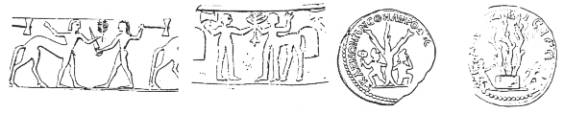
Decorations on Carian potsherds, 7th cent B.C., A.B.Cook, Zeus, pp.615f., fig. 513f. F.Dümmler, "Pithosfragmente aus Datscha", in: Ath
Mitth, XXI, pp.230f., fig.1 & 233ff.pl.6.
In the deep counterpoint between the
guardian of animals (the shepherd) and the killer of animals (the great
hunter), the theme of nature is enacted. In Mesopotamia there is no visible
conflict between Gilgamesh, the violent hunter and Enkidu ("son of
Enki", the highgod) living together with the herds, eating grass, protecting
the animals against lions and hunters. But in iconography Enkidu is always
killing the lion, not the ox. The naked figure so often seen on Mesopotamian
seals with the triple belt around his waist and a curly hairdo is perhaps not
called Gilgamesh. It probably would be more correct to call him "the
hunter". His hairdo is meant to be similar to a lion´s mane. His partner,
the bull man with legs and tail and horns of a bull has extremely long hair and
breasts. He is androgynous, being one with primordial unity (The
earliest Christian ascetics living in the Syrian desert called themselves boskoi = "shepherds"
and had hair "as long as the wings of the eagle"[70].)
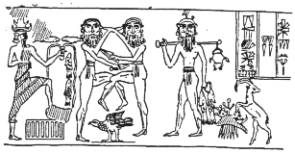
Illustration
from RA V.1902, p.130; VI, 1907
pp.106ff. (seal of Lugalanda)
The many thousand seal impressions
and seals found in the Middle East is very valuable iconographic material, but
only few descriptions of the religion in the Middle East draw upon this
material. Exceptions are the works of Othmar Keel and Anton Moortgat, Tammuz. Der Unsterblichkeitsglaube
in der altorientalische Bildkunst,1949, but an attempt was made already by
the Danish bishop Fr.Münter, Die Religion
der Babylonier,1827. Moortgat thinks that the hero we
have called "the hunter" is Tammuz, but this would not explain the
pictures where two "Tammuz-twins" are trying to kill each other on the ill. above (from Moortgat´s book). It is important to
understand that Moortgat´s socalled Tammuz is not Tammuz, but the guardian of
the gate. Originally this is the job of the young calf, the bullman, but their
roles are getting mixed up and in Mesopotamia it is mostly "the
hunter" who has this job. So the hunters killing each other are a symbol
of duality dissolving into mystical unity (see below) symbolised by the eagle
of ecstasy taking off. The bullman has long hair reaching his belt which made
scholars identify him as Enkidu. In the Gilgamesh-epos Enkidu is described as
having "hair like that of a woman" (I,100) and "he eats grass
with the gazelles" (I,105). Enkidu is the genius of vegetation, the
shepherd, and when the Guardian of the "Cedar mountain", Huwawa, and
the Bull of heaven are killed, poor Enkidu also has to die. Behind the plot of
this poem there is the old conflict between the god of vegetation = the bullman
and the great hunter = woodcutter.
21.f. Libanon as the
Garden of God & the Woodcutter
In an article "Die Baüme des Gottesgartens
auf dem Libanon" [71],
Fritz Stolz called our attention to "the cedars of God´s garden", Ez.
31. They are called the trees of Eden (v.9.16.18) and among them is a
"Lebanon cedar" (v.3) which reaches the clouds and is nourished from
the primeval abyss and covers all nations with its shadow (v.6). The tree has
cosmic dimension, it is the world tree, the tree of life. But God gives it into
the hands of "a strong one among the nations". It is cut down, and
Lebanon mourns for it. It is cast down to the realm of death together with all
the other trees of Eden, v.16f. Stolz compares this description with Is. 14,8
& 14,12-15 the mock-song about the "bright-shining Morningstar",
which wanted to conquer heaven and raise its throne above the stars as a throne
for a god on the "Mountain of assembly in the North" as king of the
gods and "equal to the Highest". After it has been cast down to Hell,
the Cedars of Lebanon can rejoice, for after its fall nobody will ascend to
cut them down, v.8.
In the background we are acc. to Stolz able to se the
contours of a myth about the garden of God in Lebanon, and a divine and
cruel woodcutter, and Stolz turns to the Mesopotamian epos about Gilgamesh ,
who comes to the Cedar mountain also called "the dwelling place of
gods" to cut down the cedar "which pleases his heart". By this
act he is confronted with the guardian of the cedar forest, Huwawa. This wood
of Huwawa's is situated 3 times 50 double-hour's journey from Uruk, and acc. to
an old-Babylonian fragment of the poem [72],
"Saria and Lebanon" tremble before the words of Humbaba, cf. how
Lebanon and Sirjon are leaping before the voice of JHVH, Ps. 29,6. In the
Sumerian version it is called "the land of the living" (i.e.
paradise), and the reason for going there is to avoid death and "erect
one's name, where the names are erected/set up" (Gilgamesh and the land
of the living, line 23ff.). Also the Ugarit texts talk about "the
pride" of Lebanon as planted by El [73]
but here it seems only to be wine trees.
The original myth is acc. Stolz
about the garden of God in Lebanon and a "Gottesgarten-Frevler", a
"bandit" trying to do violence to the garden, but cast down to the
realm of death. And this bandit was at an early stage of tradition identified
with Gilgamesh.
We do not agree with this
interpretation. Stolz ignores the strong connection to the sacred
kingship-ideology. Is. 14,8ff is a mock-song about the fall of the mighty king
of Babylon, the Mesopotamian king is the sun warrior travelling in the course
of the sun mounting even to heaven to rule over the four corners of the world.
This ascension to heaven above the stars is acc. to ancient cosmography also
seen as an ascension unto the top of the mountain of the gods, the paradise
mountain. But as in South Arabia the role of the sun warrior is totally fused
into one with the role of the hunter. The king is also the mighty woodcutter on
the sacred mountains of Lebanon, cf. the kings who boast of exactly this
achievement. (Nebukadnezar in the Wadi Brissa-inscription in Lebanon showing
the king as hunter taming the lion and as woodcutter. Acc to this long
inscription his main achievement was to cut down cedar trees and transport them
to his home. But he also erected a stele celebrating himself as "eternal
king" of the area, able to give rich blessings to future kings if they
follow his law and ordinances). In a very important book, Ch.Penglase, Greek Myths and Mesopotamia, 1994, it is proved that the younger gods of
Mesopotamia, Inanna, Ninurta, make such travels to the world mountain Kur to get power and L-I.Ringbom[74]
tries to prove that even some Romans (Marcus Antonius) acknowledged, that he
who could rule over the sacred high place of the Magi, Shiz in Azerbeidjan
considered to be the centre of the earth, had the power to call himself
"King of kings". Huwawa has 7 me-lám (glories, spheres? [75])
He is the personification of the world tree. In the earliest periods the
Mesopotamian king carried as a sign of honour a branch from the tree of life
with 7 shining balls [76].
The cedar mountains were, since time immemorial, considered to be the dwelling
place of a god who was god of the evergreen cedars and had the tree of life as
his symbol (Bata, Huwawa). When Philo of Byblos tells us about the god Elioun
(= "Highest") who outside Byblos was killed in an encounter with wild
animals, this is the myth of the Highgod killed by hunters changed into beasts
of prey. Much later in the Hellenistic period the name of this god was Adonis,
the same name as the god of Israel, Adonaj (= My Lord). He is killed by another
god with connection to the sun, the fire, the war, in Hellenistic time Ares or
Apollo, but originally Resheph. We meet these two by Philo of Byblos as Uranos
(= Heaven), who at the "centre of the country" was castrated by El
Cronos. The centre is the "navel" of the earth, the place for the
world tree and the garden of god.
The Adonis-river, today called Nahr
Ibrahim throws itself into the sea after a course of only 30km. From its source
in a cave by Afqa to sea level there is a fall of more than 1000m. It cuts
through a landscape beautifully described by E.Renan [77].
At the beginning of this century it was still covered with wood. This is the
Cedar valley where Bata lives and from where the rushing water takes the lock
of hair to the bank of Egypt.
Here on the seventh mountain
Gilgamesh finds the Erin-tree. The
seven mountains are a kind of ladder to heaven.
Baal Saphon means the "Lord of
the Look-out" Mountain. The same meaning must be attached to the holy Mt.
Ida from Greek myth. Saphon also becomes the word for "North", for
the Look-out mountain is the cosmic mountain with its top in the North Star, the
centre and turning-point of the universe. It is also the paradise-mountain,
marked out by its beautiful smell. When the Song of Songs 8,14 calls upon
"the stag on balsam mountains" it is the Highgod living on the
paradise mountain, and the leafy hut (Cant 1,16, Theokrit 100ff.) is the
primeval hut on the paradise mountain (Ps 76,7), the bridal chamber for the
holy wedlock between the God of blossoming spring and the black Sulamit
symbolising Jerusalem and the black earth. There is a kind of hierogamy linked
to the epiphany of this god of blossoming nature, cf. that Eliun loved Beruth
(Philo,I,10,15).
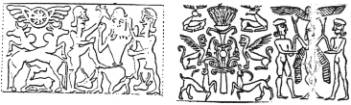
There are many seals showing the
killing of the Highgod by the primeval twins. The 2 below are from Mitanni.
Note that he is a figure parallel to the tree of life on the 2nd seal, on the
first he is parallel to a triple bull symbol. On the 2nd his twisted legs show
that he is duality united to one. The twins are a symbol of duality = creation.
(Frankfort, fig. 52,53,90)
That Huwawa is the highest divine reality
is seen from the triple arrangement on his head: the central pillar flanked by
the two pillars of the sun gate. The legs of the primeval twins are intertwined
with the legs of Huwawa (slab from Tell Halaf). Something similar is seen on an
ivory carving from Nimrod (Mallowan II,fig. 457,p.538) where the legs of the
twins seem to “grow” out of the legs of Huwawa. The motif shows reality in the process of dividing into duality. On the last
picture it is clearly seen from the plant-like arrangement on the head of
Huwawa that he is the highgod of vegetation. (Bronze dish from Nimrod. 800 B.C.
[78].)
Huwawa is divine reality in the way that he is the kundalinipower raised to its
highest level, the forehead: “…from his forehead which devours trees and reeds
none escapes” (ANET,p.49). He can “fasten the eye of death” on his enemy. The
forehead is the position of the “third” eye. Like the eyes of Medusa and the
uraeus of Pharaoh his forehead becomes a magic weapon.
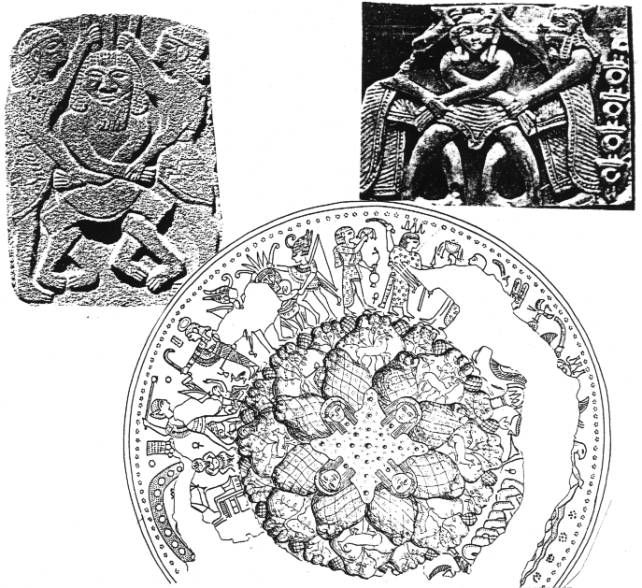
The
sun hero is standing with the crown of Osiris between his two servants
providing the water of life flowing from his servants cups, cf. below the
second last chap. of this book:" He who brings the water of life". He
is branding a curved club. In the centre of cosmos the well of life with four
rivers and the goddess as the symbol of the primeval cube.
The Westsemitic Highgod has a name
that means "God". He is the original god and creator: In Palmyra he
is called ´lqwnr & ´lqnr [79]
meaning "God the creator". In the Bible he is mostly called Elohim,
but also "Elion (= Highest) creator of heaven and earth" (Gen 14,19)
In a Hittite text he is called Elkunirsa (El, the creator). But he has most
often become a very distant god with Baal/Resheph, the hunter, Anat the very
violent huntress, Astarte the prostitute, and Qadshu the stark naked filling
the gap.
Obviously he is the Uranos castrated
by El Cronos/Resheph and the Hypsuranios ("Highest Heaven") fought by
his brother Usoos in a myth told by Philo. Usoos was the first to hunt animals
and make clothes of their skin (he is a new version of the great hunter).
Hypsuranios was living in a hut of reeds. They both lived in Tyre so Usoos must
be East Tyre or Palaityros also called Usu. This means that Hypsouranios must
be West Tyre, situated on the small island which, judging from coins, was
called "Ambrosian rocks" and where, acc to Nonnos and Achilles
Tatios, a wonderful tree, was growing in the "navel" of the island
with a snake coiling up its trunk and a bowl in the top (THE WORLD TREE IN THE
NAVEL OF COSMOS). So the conflict between Usoos and Hypsouranios in the hut
made of green vegetation must be the conflict between hunter and highgod.
In the longest Ugarittext, the epos
about the fightings of Baal, El is not directly killed by Baal, but his two sons
Jamm, and Mot (= Death) are, and they are obviously personifications of the
duality latent in El as primeval totality, living inside the Mountain of night
(Lel). Jamm is "Sea" going beyond its borders and Mot
("Death") is summer heat going beyond its limits. So Baal is seen as
the creator of fixed order. He is the ruler of this world while El is exiled to
some distant transcendence from where he can only rule over the streams of
life-giving water. But also Usoos has to survive a universe exposed to the flood
of great rainstorms, and afterwards the burning down of the forestland. As the
one who accomplished the first journey over the sea he must be identified with
Heracles/Melqart who acc to Nonnos (40), was the first to take steps to sail
the sea. By this the first people of Tyre reached the holy swimming island where the world-tree with the coiling snake was
growing. In its top an eagle was flying. This bird they had to capture and
bring as a sacrifice to Poseidon and by this act the swimming island was grounded
outside Tyre. Here again the hunter Usoos-Melqart creates fixed order in a very
floating universe. Now the eagle was a symbol of Baalshamem, the Highgod of
Tyre, so the pattern is everywhere the same: The Highgod is killed by a god
becoming the ruler of this visible world.
It should not be denied that
the religion in Byblos was a kind of “Death-of-God” theology. First the
“Highest” (Elioun) is killed, then Uranos is castrated and killed by the cruel
El Kronos, who then introduced the sacrifice of children. Inscriptions show
that there were both a Baalshamem and a Baal ´adar in Byblos about 500 B.C. [80],
probably identical with Uranos and El Kronos.
In Tyre both a Hypsuranios and a Melqart Usoos, in the Osiris myth
brought to us by Plutarch both Osiris and Malk-ander, king of Byblos, cf. Bata
and Pharao. There seems always to be a Highgod and a younger god closely
connected to the king.
When El Cronos is followed
by the “gods” as his allied it is the train of demons who have rebelled against
the highest. Chwolson´s description of Saturn in Harran shows that he was
definitely the black and scarying god (see below), and Resheph is finally
apotheosized as Saturn. The sacrifice of children is depicted as a magic-occult
ritual. The children were immolated as a “ransom to revenging demons after a
secret ritual” (mystikôs) says Philo I,10,44. It is by the
help of “the magic spells” of Hermes Trismegistos “used on the allies of
Cronos” that “the lusting/ the desire” (pothos)
for battle with Uranos “is instilled in them”. Acc. to Helck,[81]
Resheph in Egypt under Amenophis II becomes the model taken by the king dashing
forward in battle. There is a plural form of his name rshfm, he is like Odin the ecstatic warrior dashing forward followed by his band of demons. With
his own hand he killed his son Sadidos, a brother, Atlas, was cast down and
buried in the depths of the earth, and he beheaded his own daughter “so all the
gods were terrified by the thinking of Cronos” (I,10,21) It is the old ecstatic
warrior-ideology described by Widengren and Wikander, taking force from the
dark side in man, but in the long run having tragic consequences for even his
own family.
Resheph is related to the
Mesopotamian Nergal, by A.Parrot [82]on
the basis of seals and figurines described as a man lying in a sarcophagus with
sickle swords in both hands, surrounded by jars, and accompanied by two
monsters: snakes rising out of a lion’s mouth on the sarcophagi.
One could also ask if the
key to some important motifs of Phoenician religion, the sacrifice of children
and the worship of the prostitute as the epiphany of the goddess, qds (=
holiness), is not to be found in the close parallel to similar practices in
devil worship and the Indian left hand tantra? If this is so, the Phoenician
religion has its roots in early agricultural societies serving Sandan but is,
within historical times, in the process of stiffening to folklore and
tradition, the inner meaning of which is no longer understood by the majority.