27. The vision of ultimate reality
The
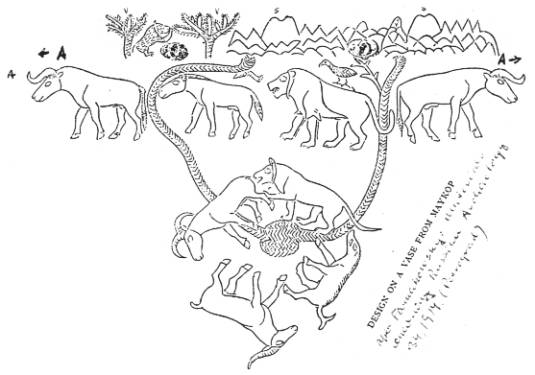
imagery of Maykop is very close to that of the earliest culture of the Middle
East. We find the whirl of animals in Hierakonpolis (prehistoric Egypt), at prehistoric
Susa, and Mohenjo Daro. Animals of very different horn-shape and color are, in
the centre, united to one by the strange prolonging of leg or body (in
Hierakonpolis). Also in Maykop the symbolism from bottom to top is a movement
from centre and unity to duality. At the bottom of the jar is the mystical well
of life in the mystical centre of the universe. At the top, contrast and
duality are pictured in several ways:
Two bulls confronting each other in contrast to
different animals chasing in the same direction.
This
picture is a sort of Russian parallel to the biblical vision of God carried by
“life-creatures" melted together from 4 different animals (Ez 1-3) and
standing by the crystal sea.
Two pillars of stone in contrast to two pillars of vegetation.
Acc. to Zach 14,6-9 the contrasts of life will disappear
(heat and frost, day and night), for the unity of the Lord and the day of the
Lord, which is all light, and the mystical well of life, will spring up at
Jerusalem and divide into two.
This symbolism of unity and duality is very typical of
mythological thinking and also found in primitive philosophy. In Pythagoras and
Plato the number One is a mystical symbol of God, and limitless duality
is the evil principle.

Müller-Karpe, IV, 3, t.718, 1

Sakjé-Geuzi, North Syria 11-8.cent. B.C. SYRIA V, pl.1
Also the tree of life can be shown as a hybrid – fused
together by 3 different symbols of vegetation, and over it hovers the sun bird,
a fusion of bird, rosette, moon sickle and two fruit- bearing wreaths being
picked by the two genii. The tree of
life as a hybrid is also mentioned by J.de Moor in his article “East of Eden”[1].
The double bull arranged as a pair reflecting each other is also a symbol of
ultimate reality, duality becoming one. On the seal from Mohenjo Daro above it
is seen united to the tree of life(?).
The high god is the giver of vegetation, therefore his
epiphany can be the old gigantic tree, the highest tree overlooking the whole
area. His finest symbol is the “tree of life” with the “well of life” at its
root, and perhaps even the “coiled one” as a symbol of primordial, amorphous
matter. As a divine symbol, the tree is carrying fruits of diamond and sapphire
and seven globular lights on its branches to mark the mystic unity of all
light, the light of the sun and moon and 5 planets. The Menorah is a
typical symbol of God as the source of all light and life.
The ecstatic character of the snake coiling up the tree is
often stressed by the bird of ecstasy flying in the top of the tree.
The blossoming staff of Aron is the old royal scepter
seen as a branch from the tree of life[2].
The arc of the covenant contained a branch from the tree of life and a jar with
the manna = “the bread of life” (so
Ruprecht). Later “the tree of life”-aspect of Yahveh was represented by the
Menorah.
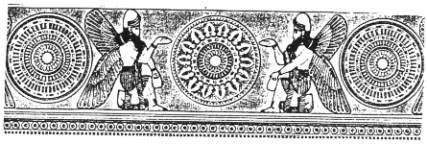
The plant of life, the mystical rosette being nursed
(pollinated?) by genii; under it 4-fold totality and double bull becoming one:
the mystical centre of the cosmos, Khorsabad, 8th cent.B.C.[3]:

Mysticism, that very specific experience of transcendent reality breaking
through the normal day-to-day sensation of color, smell, and sound, opening up
to both heaven and hell, is as old as man's contact with God as the upholding
power of life and light[4].
It is important for the desert-life of both John the Baptist, Jesus and Paul as
for the early monks searching for unity of heart. It is important for the
beginning of western philosophy[5],
as it is important for the understanding of religion in Catal Hüyük, the vision
of Ezekiel, and the longing for androgynous unity among Syrian ecstatics.
To
me as a theologian the army of demons is a reality. And mystical visions of ultimate reality as the uniting force
behind all love and light and life in the universe are a reality. Only modern
man tries to close his eyes to this reality so often experienced in religion,
and expressed in its iconography. That mysticism is an important feature in
Jewish and Near Eastern religion as early as at the time of Jesus & Paul is
proved by Philo of Alexandria: when the high priest has to go into the debir, he changes from clothes of many
colours (symbolizing this world) to a white dress symbolizing divine light:
standing before God the priest is taken from the plurality of the world and
united to divine unity and the transcendent most clear light. When Abraham went
out from Ur it was like the opening of the eye of the soul after a long sleep,
and he saw the clearest light of God[6].