1.
Tyre
In Philo of Byblos' History of the Phoenicians we find the following description of the highgod called Hypsuranios = “High Heaven”:
“From
these (the primordial mountains),” he (Philo) says, “were born Samemroumos, who
is also called Hypsuranios, and Usoos.” He says, “They took their names from
their mothers, since women at that time mated indiscriminately with whomever
they chanced to meet.”
Then he says that Hypsouranios settled Tyre, and that he invented huts
made of reeds, rushes, and papyrus. He quarreled with his brother, Usoos, who
first discovered how to gather a covering for the body from the hides of
animals which he captured. Once, when there were fierce rainstorms and gales,
the trees in Tyre rubbed against one another and started a fire and it burned
down their woodland. Usoos took part of a tree, cut off the branches, and, for
the first time ever, dared to travel on the sea. He dedicated two steles for Fire and Wind. He worshipped them and
poured out to them libations of blood from the animals which he had hunted. He
says that when these men died, those who survived them dedicated staves to
them. They worshipped the steles and conducted annual festivals for them.
Hypsuranios
is the highgod of Tyre living in huts of reeds, etc, i.e. being one with the
green vegetation. He is fought by the great hunter, Usoos. Through rainstorms
and burning forests Usoos traces the course of the sun with the first attempt
to sail the sea. First water, then the opposite pole, fire, go beyond their
boundaries. By sticking out the course of the sun and putting up the two rods
forming the gate of the sun, cosmic order is created.
The
festival commemorating this is also celebrated in memory of a time of chaos
with 1) rainstorms, water and fire not being able to find their proper limit
and balance in the universe 2) women mating freely 3) the two brothers, the
symbol of duality fighting each other.
Cosmic
order is set up by the two pillars of the sun-gate being raised, duality
finally being established, cf. how the clashing plangtai were fixed by Jason's penetrating the great gate to the
land of the sun.
The
background for the biblical version of the flood (known from both Greek, North
Syrian and Babylonian myth) is also fear of the ocean, the great abyss breaking
its bounderies and uniting with the waters from above, and God´s promise Gen
8,22 is a promise of securing cosmic balance between ”summer and winter, day
and night”, cold weather and hot weather. The sun shining on the dewdrops of
the rainbow is a symbol of this balance.
The background for the biblical version
of the flood (known from both Greek, North Syrian and Babylonian myth) is also
fear of the ocean, the great abyss breaking its bounderies and uniting with the
waters from above, and God´s promise Gen 8,22 is a promise of securing cosmic
balance between ”summer and winter, day and night”, cold weather and hot
weather. The sun shining on the dewdrops of the rainbow is a symbol of this
balance.
A
wall-painting from one of the east walls of Catal Hüyük shows three bull’s
heads between the poles forming the gate of the sun. It is the trinity of the
high god.
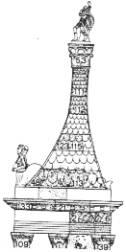
In
the lobby of Römisch-Germanische Museum in Cologne is reconstructed the
beautiful memorial of a Roman officer. Its roof has the form of a pyramid
covered with stone flakes similar to the flakes covering the pine cone, the fruit
of the evergreen tree of life: the top of the pyramid is the summit of the
world-mountain. In the depth of this mountain the bodies of the family rest and
at THE TOP, THE SUMMIT, THE HERO OF LATIUM & ROME, AENEAS carrying his old
father on his back and guiding his son by the hand. The triple sun-hero has not
only reached his ultimate destination in the far west (Latium/Rome) but also
the highest point of the sun-hero’s life-journey, the navel of cosmos, the
everlasting mythical mount beyond the ocean. At the bottom of the roof are
shown two sea monsters, a mixture of dolphin and horse; the hippocamp is the animal bringing the
Tyrian god, Melqart, over the great sea to the sunset in the far west – the
motif is very common in Roman-Hellenistic art. (G.Precht, Das Grabmal des L.Poblicius 2.ed.,1979,fig.
38f.)

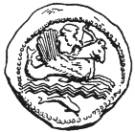
Old Tyrian coin (400 BC) showing Melqart
travelling over the sea on the back of the hippocamp.

The
maritime motifs so often met with in Roman funeral art, including a journey across
the sea on the back of a hippocampus must be understood on the basis of
eschatological hopes and aspirations taken over from the cult of Melqart in
Tyre and Europa in Sidon. Below, the sarcophagus of a Roman woman, where the
deceased is seen lifted up in apotheosis by hippocampi. (Roscher,V.1194f,
fig.25)
The
triple sun-hero fighting his way over the Western Sea is also behind a very
short remark by Philo of Byblos:
Uranos,
his son Demaros and Demaros' son Melqart went to war against the “Sea”, were
nearly defeated and had to promise an offering to escape. Also Odysseus has to
accept help from both his father Laertes and his son Telemakos, and when he has
finally won over the suitors, their bodies lie like fish brought up on the
beach. The sun-hero has finally conquered the Sea of Chaos to make way for the sun to shine and establish cosmic
order, see below the chapter on Odysseus.
The strange story about the high priest
Sichaeus living upon the Island of Tyre with his wife Elissa becomes
understandable in the light of the killing of the bull-god during a boar hunt.
The story is told by Menander and Justin. Acc to the latter, the Tyrian king
died on his deathbed sharing his royal power between his daughter Elissa &
and his son Pygmalion, who, acc to Menander, was only 9 years old.
Now,
Pygmalion plotted against his brother in law, and finally got him killed during
a boar hunt where he was pierced by a spear in some arranged accident. His
ghost shows itself to his wife telling her the truth. Sichaeus was known to
have a hidden treasure on the island, and Elissa promised to hand it over to
her brother if he sent ships to carry it. Having done so, Elissa carried many
bags of sand onboard the ships, but at high sea she made an offering to the
gods, plunging all the bags into the water. Now the seamen, realizing that they
would be severely punished when they came back without the treasure, decided to
follow Elissa on her flight to North Africa where she founded Carthage, and
this is the mythical story of the foundation of this city.
Certainly
Sichaeus is the high god living on the paradise-island with the ambrosian
rocks, and ruler over all the gold of transcendent glory. He is El with his
wife Elissa, but he is killed by a younger god, acc to Justin still a boy (admodum puer). And his body is left
unburied, thrown into a pit. Now the gardens of Adonis were thrown into the sea
at the end of the feast, and in Byblos we find the myth that El Kronos killed
his brother Atlas and threw his body into a deep pit. Both Sichaeus and Adonis
are avataras of the high god being killed by a younger god during a hunt.
This
is the myth retold in another version by Philo of Byblos: Hypsuranios is fought
by his brother Usoos, where Usoos, like Pygmalion, is living in Palaityrus,
also called Usu. Usoos being a hunter, Hypsuranios being the god of vegetation
who was the first to construct huts of reeds and papyrus, it seems rather clear
that H. is the dying god of vegetation.
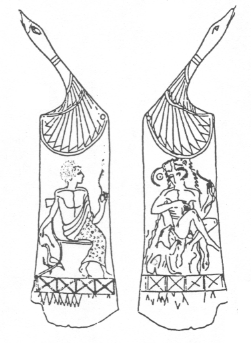
The two gods representing vegetation and fire are also seen on a Punic
razor[1].
On one side of the razorblade the naked hunter with bow and dog, and with the
club of Heracles and the lion´s skin hanging down his back, on the other side a
young god sitting in the posture characteristic of Baal from Tarsus, the
highgod contrasted with Sandan, the dynamic god. The god of vegetation is
feeding a bird with a stalk of vegetation, and has his face turned towards
another stalk or an ear of corn, where the hunter has his face turned towards
the symbol of mystical fire: a star in the crescent moon. The same symbol is
seen over the head of Melqart on a ring from the 4th cent. B.C. from Bordj
Djedid[2].
This Melqart brands his double axe in one hand, and with his bow in the other
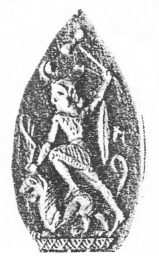
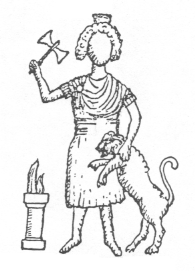
hand he is subduing a lion. A small picture from Palmyra shows the hunter with
his axe standing close to his element, the fire subduing the lion. He is
closely connected to the world pillar[3].
The biblical hero Samson does not ascend in the pillar of fire on the altar as
Heracles on Mt Oite, but the angel foreseeing his birth does, Judges 13, and he
dies by turning over the two great pillars in the temple, symbols of the gate
of Heracles.
The scene where he visits a whore in the town of the enemy, rises at
midnight, and has to break out of the town by lifting the gate out of its
post-holes, is a symbol of the sun hero having holy wedlock with the opposite
pole in cosmos, the dark queen of the underworld, (as Nergal and the queen of
the nether world) and at midnight beginning his ascent through the iron gates
of hell. The myth is found much later
in the Mandaean story about Hibil Ziwa´s wedlock with the princess of the
underworld.
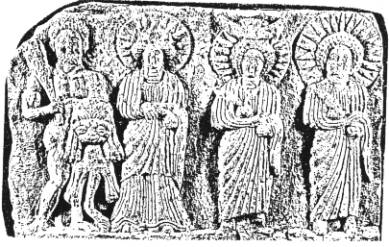
On a relief from the temple of Bel in Palmyra Heracles is seen with a
conquered lion and his wife, the goddess, and the two holy twins (a new version
of the triple sun hero).
But
he can also be seen as a bowlegged dwarf (Pygmalion, cf Greek pygmaioi, the Pygmies, cf. the
Bes-figure so common in Palestinian art) and later as the child Amor.
The
city-founding myth is a myth about creation out of chaos. In Rome the tracing
of a fixed borderline by Romolus ploughing.
In
Tyre the creation of the city involves the killing of the bird of ecstasy
flying in the top of the burning tree and in an universe without border-lines,
going from one extreme to the other - from fire to flooding. Usoos makes his
first attempt to sail the sea and raises the two pillars that form the gate of
the sun, thereby creating a structured universe.
Usoos's
journey is the travel of the sun(-hero) over the sea to the rock (Tsor which is the Semitic name
for Island-Tyre), the paradise-mountain, on coins from Tyre called the
Ambrosian Rocks. The Rock was a wandering island, floating until the offering
of the bird and the fixing of the gate of the sun. The flight of the bird, the
floating of the island are symbols of the floating unfixed state of the
universe before creation.
The
tree that burns without being eaten up by the flames is a symbol: Life-juice
and fire are being held together in some sort of mystical balance (although
they are opposites). The same speculation about fire and water going beyond all
limits and being held together in the mystical APEIRON is the key to Anaximander's cosmology.
The
killing of Remus, the fighting of Hypsuranios with Usoos, his brother, is
creation seen as the splitting up of duality. Also the Bible has couples of
brothers fighting:
Cain and Abel (shepherd) 
Isaac and Ishmael (man of the desert)
Jacob and Esau (hunter)
1a. Melqart
The axe, the kilt, the scull-cap show that he
is the typical Great Hunter-type. Note that the axe is in the left hand.[4]
But he is more than that, a typical product of syncretism: like the Greek
Heracles a mixture of the mad hunter demanding the sacrifice of children (even
Heracles does this, when he returns from his descent to Hades, he is ridden
with madness and flings his own children on a bonfire) and the brave sun
warrior sailing across the great ocean to the sunset and paradise with the tree
of life, fighting to create or clear a path for the sun to run its course,
securing this path by erecting the two pillars to provide a gate for the sun. 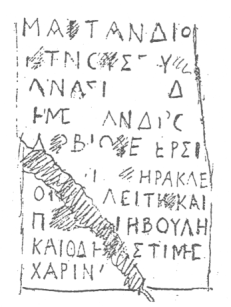 A Greek inscription found in the
environs of Rabbot Ammon/Philadelphia examined by F.Abel[5]
talks about a certain “Maphtan, son of Diogenes, gymnasiarch in two day … raiser (egerseítês) of Heracles…” This title, egerseítes, Abel compares
with a text from Menander of Ephesus quoted by Josephus[6]
where it is told that king Hyram of Tyre (living at the time of king Solomon)
was the first who celebrated the raising (égersis)
of Heracles (= Melqart) in the month of peirithios.
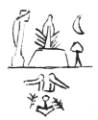
The picture is a drawing of the inscription made by F.Cumont on location and
sent to Clermont-Gannau[7]:
A Greek inscription found in the
environs of Rabbot Ammon/Philadelphia examined by F.Abel[5]
talks about a certain “Maphtan, son of Diogenes, gymnasiarch in two day … raiser (egerseítês) of Heracles…” This title, egerseítes, Abel compares
with a text from Menander of Ephesus quoted by Josephus[6]
where it is told that king Hyram of Tyre (living at the time of king Solomon)
was the first who celebrated the raising (égersis)
of Heracles (= Melqart) in the month of peirithios.
The picture is a drawing of the inscription made by F.Cumont on location and
sent to Clermont-Gannau[7]:
By Eudoksos of Knidos[8]
it is told that Heracles was dead, but was raised by his servant Jolaos by the
smell of a roasted quail. Clermont-Gannau thinks that the quail is a symbol of
Heracles-Melqart´s mother Asteria (Ashtarte), sister to Latone (the coiling
snake Ladon/ltn). Only his mother who gave him life can revive him (p.151). But
in our opinion it is much more probable that the quail refers to the great
passage of migratory birds in spring. By the appearance of the vast flocks of
quails the life force in vegetation conquered by the winter storms will rise
again. Gymnasiarch must be the leader of the sportsgames that had to revive
Melqart, the sun weakened by winter. Clermont-Gannau mentions as a parallel a
custom from the temple of Jerusalem, which really created the dismay of the
High priest and was abolished. Each morning the Levites would rouse God with
the call from Ps. 44,24: “Wake up, why do you sleep Adoni? Rise!” The Levites
with this duty were called “rousers”(ma’urrîm[9]).
Melqart is the young sun-warrior tracing his route across the sea towards the
sunset. He is a parallel to the Greek Heracles, who through 12 “labours”
completes his task on earth. In the 11th he reaches the Garden of the
Hesperides (paradise). The Heracles/Hercules-name seems to have some connection
to Nergal (Hercal). Heracles also seems to have some similarity to Ninurta. A
text composed perhaps in the Ur III period is a mixture of myth and
accumulation of praise: Ninurta returns from the kur = the world mountain and is called the “great bull of the kur”,
“the horned wild bull”, ”wild ram”, ”stag”. The monsters he is credited with
having vanquished are listed and the way they are all hung on his “shining
chariot”. He drives his cattle into E-kur (the temple as a model of the world
mountain). The reason for his journey to the mythical world mountain and his
fighting the monsters there is to gain power, and on his return to Ekur he
makes claims for “kingship of heaven”[10].
In another text a monster is born out of the union of Heaven and Earth. This
monster is coupled with the world mountain, kur, and gives birth to stone
things and grows continually, but is finally defeated by Ninurta and changed to
hur-sag (mountain) which Ninurta
heaps up over the kur and thereby subdues the floodwaters which emanate from
kur and arranges for the waters to flow into rivers and canals[11]
(cosmic organization). These travels of the god to the world mountain have
rightfully been compared with Apollo’s travel to Parnassos in the Homerian
Hymn, conquering the holy mountain in the navel of the earth from the
Pythonsnake[12].
In the Tyrian myth Melqart is
represented by Usoos, the first to sail the sea (acc.to Nonnos Dion 40 the credit for that had to be
given to Melqart/Heracles).
West Tyre, the island-part of the
city was founded on the swimming paradise mountain. A. B. Cook[13]
brings a small collection of coins showing the two stelai erected by Usoos.
They (or the ground they stand on) often carry the inscription “Ambrosian
Rocks”, denoting the paradise-island. As rightly seen by E.Will [14]
they are identical with the island, symbolic representations of the island. Acc
to Herodot (II, 44) these two stelai could be seen in the temple of Melqart,
one made of gold, the other made of emerald glowing in the night, cf Theophrast
(lap.24) who also mentions the
emerald stele. Acc. to Philo (I,10,10) they were consecrated to wind (giving
rain and vegetation) and fire (the burning summer heat). They are, as we can
see, a symbol of the two great poles in cosmos experienced by Usoos in the
fierce rainstorms (of winter?) and the fire burning the woods. The coins also
show us the wonderful tree growing in the midst of the rock.
However, sometimes it does not grow
in the centre but is moved to the right, and a fire altar is standing to the
left. Obviously the mystical burning tree in the real world had to be
represented by two cult objects
which only gave the spectator a glimpse of what was meant to exist. While the
burning tree symbolises the mystic unity of the two divine poles (vegetation
and fire), the duality of the visible world is represented by the two stelai
the golden for fire, the emerald for green vegetation.


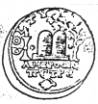

Will does not understand why a small
stream of water on the last coin is seen gushing forth from the Ambrosian Rocks
(“this detail must stay unexplained”). The explanation is simple: The water of
life is just as important a part of the paradise-symbol as the tree of life.
Will mentions that the same cult inventory was found in the temple of
Heracles-Melqart in Gades. An eternal fire is mentioned by Silius Italicus
(III,29: irrestincta focis servant altaria flammae), and there was
also in Gades a model of the tree of life in gold with fruits of emerald.


J.Morgenstern ("The King-god among
the Western Semites and the meaning of Epiphanes")[15]
has a bold and very interesting suggestion of what ideas were at the very
centre of the temple cult in both Tyre and at the temple of Solomon. The notion
of the pillars of Heracles seems to play an overall important role in Tyrian
mythology. Strabo tells us that Tyre sent out several expeditions to look for
the exact position of this Western Gate. Acc. to the oldest tradition they were
in the Middle of the Mediterranean and the first attempt to sail the sea
resulted in a landing on their island. Later they were localised at Gibraltar,
later still farther west by Gades and at last by Cape Vincent, the South West
corner of Portugal.
Now acc. to Morgenstern Baalshamem´s
eagle was a Phoenix ever renewing itself in fire, and the young god Melqart and
the old god Baalshamem were one. The
young god travelled, fighting his way across the sea. But as the year grew old
and the seasons shifted to autumn and winter he would grow weaker and finally
go down to Hades.
But like for the Phoenix when it
feels it has to die, a flame will break out of its body and consume it, so
Melqart is burned in fire but renewed out of the ashes giving rebirth to
himself in a never ending cycle, always like the rising sun ready to make a new
journey pouring life and energy into nature.
Morgenstern is right in stressing
that Baalshamem is the god of the uncleft world mountain, (i.e. the paradise
mountain with the bird of ecstasy flying at the top of the tree). In the myth
he is represented by Hypsouranios. And Melqart is the god of duality, the world
mountain split into two pillars, as Usoos putting up the sun's gate.
Morgenstern’s understanding of
Melqart has not won the general acceptance of the scholarly world. A very
thorough investigation into the nature of this god, the doctoral thesis of
C.Bonnet[16] has only
little to say to the attempt of Morgenstern.
Clem recogn. X,24 tells us that “the grave of Hercules was shown in
Tyre, where he was burnt in fire”. But by that time sacra Herculis were long ago transferred to Gades (Justin 44,5),
and Mela says “his bones” were put to rest in his sanctuary (3,6).
Bonnet is right in stressing that
the words “rouser of Heracles” covers over a cult-title. A human “up raiser”
(mqm) plays an important part in the ritual [17].
Bonnet does not seem to notice that this human helper is also represented in
the myth by Jolaos trying to wake up the god by the good smell of food, and
Hermes or Cadmos trying the make Zeus/Sandan energetic by restoring his sinews
to him. Both gods seem to be in some state of immobility from which he is
brought into “energy” by a human helper. This unenergetic state is the
primitive notion of the state of the dead souls in Hades. Melqart-Usoos is a
god not reborn, but raised from the underworld coming hungry and eager to
partake in the meal of roasted flesh. I think Bonnet is underestimating the
chthonic element in the nature of the god. As the first to sail the sea he is
one in the row of the many benefactors of the human race enumerated by Philo,
but all living in a distant past. The dance to his honour described by Heliodor
(Aethiopica IV,17) is a very wild
dance, where the dancers act as if obsessed by demons: ”Soon they would jump
sky high in the air, soon crouching on the ground and whirling around
themselves like possessed by demons”. Such dances reaching beyond exhaustion
into a state of trance have as their main purpose to lead to ecstasy and an
experience of obsession by forefathers coming from a distant past.(Ex.: The
ghost dance from North America). Melqart is the spirit of the great hunter, the
first to kill animals and make a kilt from their hide.
Bonnet stresses [18]
that the two items seen on the coins are not the pillars of Heracles, but
stelai with a rounded top unable to serve as pillars. But the special form of
the stelai shows that they are in fact the world mountain cleft into two, and
in its function as the gate of the sun it can also be drawn as two pillars.
It is a picture of primordial
totality dissolved into duality, and therefore they could also be identified
with the polarity “fire” and “moisture”. Another symbol of duality and mystic
unity is the famous tree surrounded by flames. By Achilles Tatios the paradox
is stressed: “The plant is nourished from the fire”, “Athene (the owner of the
sacred olive tree) does not fly from Hephaistos”.
On the walls of the gates to the
temple in Gades were pictures of the “labours” accomplished by Heracles, but
not those located in the far west: the fight with Geryon, the encounter with
Atlas, and the intrusion into the garden of the Hesperides. In their place and
at the centre of all the labours was seen the big bonfire of apotheosis.
Obviously this was where acc. to Tyrian tradition the story ended, not in some
bonfire at Mt. Oite, but if Melqart’s journey was the journey of the sun to the
sunset, the fire had to be the final goal in the utmost western part of the
world.
Like her teacher E.Lipinski[19]
Bonnet has chosen to pay special attention to a small vase from the
Pergamonmuseum - now disappeared – possible date 4th cent.B.C., about 15 cm
high. Along the brim of the vase an ouroboros-snake and on the vase some gods
(?), one standing with birds surrounded by symbols of vegetation and with the
name Baal kr. acc. to Lipinski “Baal
of the furnace/oven”. But where is that furnace? In my opinion it is safer to
translate: “Baal of the worldmountain” (kur.
In Ebla the most prominent god was Kura, the tutelary god of the king and queen
of Ebla.) One scene shows the god burning between a high pole with a snake
ascending and the crescent moon over an incense burner (?), the anchor
underneath could point to Gades. The scene above Baal kr shows Melqart standing
in his temple with two Dioscuri as servants, each in a side chamber. How the
two figures on each side of the burning altar could be identified is not easy
to see, but they are dressed in much the same way and seem to hold the same
instrument. The 4th scene shows the mystical bird over a symbolic
representation of the primordial mountain and two priests attending this holy
symbol. Acc. to the interpretation of Lipinski-Bonnet, it is the mausoleum with
the ashes of Melqart.
1b. The Hanno Expedition
At the end of the 5th cent.B.C. a fleet of 60
warships and about 30 000 men and women led by admiral Hanno went out from
Carthage. The goal was the foundation of new colonies west of the Gibraltar.
Hanno´s report was later written on a slab and put up in the temple of Saturn.
The text is preserved in Greek translation in a hand writing not older than 10th
cent.A.C. and perhaps somewhat spoilt through copying. J.Blomqvist [20]
pleads for a date before 400 B.C. for the Greek translation. Most scholars have
been eager to find a historical kernel behind the text. But great problems arise
when the last part of the report is compared with the geography of our present
time. The first part of the route can easily be identified: along the coast of
present Marocco are founded 6 towns and a temple. From here the fleet sets out
for the river Lixus, where a friendly population received them and where they
stayed for some time and got interpreters for the trip farther south. From
there they sailed south for two days, and then east for one, and there they
founded the last colony, the later on so famous city of Cerne. But now
something strange happens to the distances. Until now they have been sailing
for ½-2 days between each landing, but then suddenly Hanno sails for 12 days
and reaches high mountains covered with sweet smelling trees. It takes him two
days to sail around the mountains, and now they reach a great bay, which their
interpreters called the “the Western Horn”. In the bay was situated a big
island, on the island there was a lake with salty water, and in this lake
another island. They went ashore, and saw nothing but forest, but when night
came, they heard the sound of many voices and flutes, drums and cymbals. They
were seized with fear, and the omen takers ordered them to leave the island.
Then they sailed along a fiery coast for 4 days. The coast was full of “burning
incense”, and great streams of lava were running to the sea. By night they saw
that the whole country was full of flames, and halfway a giant flame which
seemed to reach the stars. When daylight came, they saw that it was a big
mountain, which they called “Chariot of the Gods”. After three more days of
sailing along more burning coasts, they finally reached a bay called “the Horn
in South” and here they were met with the same scenario as at the Western Horn,
an island with a lake, and in the lake a smaller island full of wild human
beings called gorillas by the natives. Most of them were women, and the
colonists succeeded in catching a few, but the male species defended themselves
with stones.
The only volcano high enough to meet
the description of a top reaching the sky is Mt Cameroun, and is it really
possible that Hanno would go so far with such a big fleet? The state of the
wind is such around the Equator that the Punic sailors would have to row in the
immense tropical heat. Is it really to be trusted that the fleet by mere chance
should come across a volcanic eruption of such dimensions and is it really to
be trusted that the Berbian speaking interpreters would be able to understand
the language so far south? And the Punic merchants would not be interested in
founding colonies so far south where the long and dangerous routes of transport
would swallow up every profit.
It is much more likely that the last
part of the “report” is moving into some kind of mythological landscape. A
Hellenistic novel called “Wondrous Things beyond Thule” tells about a brother
and a sister from Tyre making journeys which take them even beyond Thule to the
island of the moon. At the top of the typical Phoenician semeion, symbol of the ascension to heaven, the moon is situated as
the top of the heavenly journey. The two “Horns” are the horns of the crescent
moon. The burning landscape is the light of the moon, shining (=burning) by
night.
The island situated in a lake on
another island in a bay is typical omphalos
(=world-navel”) and world mountain symbolism: the primordial island
emerging out of the primordial salty sea in a double “emerging”. But it is the
split world mountain, and to the first “horn” is attached the culture of the
hunter: ecstatic music - to the second the symbolism of man being one with
nature and hairy like an animal.
du Mesnil du Buisson (Tess.pp.427ff.) has collected several
drawings of the Westsemitic Semeion. He thinks the discs could symbolise the 4
elements. H.Ingholt [21]pleads
for the 5 planets and sun and moon, and this is in fact the right explanation.
The first example shows 4 planets, the sun and at the top the moon with the
morning and evening star at its horns.


D is from Carthage, F from an altar dedicated
to Semia in Dura Europos. On a picture of the famous Semeion from Mabbug a
small man is climbing the top and greeted by the dove of the goddess with the wreath
of victory (du Mesnil du Buisson, Tess.
fig.261f.). Her semeion has 4 planets, the wedlock of sun and moon, and on the
breast of the goddess the morning and evening star. On C the unity of sun and
moon and morning & evening star, no.6, is given a special disc.
We need to acknowledge the strange
fact that the journey to the end of the world and the mountain of the gods is
also seen as ascension to heaven. Now we have already in the Ugarit text
“Liturgy of the nocturnal sacrifices” seen that the king travelling in the
course of the sun through the netherworld has to bring 7 sacrifices and a bird.
The bird of ecstasy sitting at the top of the semeion with its seven stages of
ascent is the explanation to this.
Now the journey to the ultimate goal
can be a geographical journey in the course of the sun to the mountain of the
gods, the mountain looking like a high pillar of fire is the mountain of god,
the symbol of unity, flanked with the symbols of duality, the two “horns”. But
it can also be an ecstatic journey through seven levels. And it can be a nocturnal journey with the sun through night and
darkness to the dawning of light. We shall later return to this last aspect.